YIYI Mesh Belt Chain Driven Belt Manufacturing Case Studies
Chain Driven Belt on the official website →
Chain driven belt projects from YIYI Mesh Belt: chain centres, chain pitch, mesh wire and support rods measured against signed drawings, plus a belt-and-sprocket supply. Published by Ningjin Yiyi Mesh Belt Co., Ltd. (YIYI Mesh Belt), Ningjin, Shandong, China. 20 pages; read online or download the PDF.
- 4 projects
- Chain pitch checks
- Multi-width orders
- Belt and sprockets
What this 20-page document covers
Each item links to the page in the flipbook above.
- Page 2 · What we check before shipment
- Page 3 · Five questions answered by actual order records
- Page 4 · From drawing review to inspection and packing
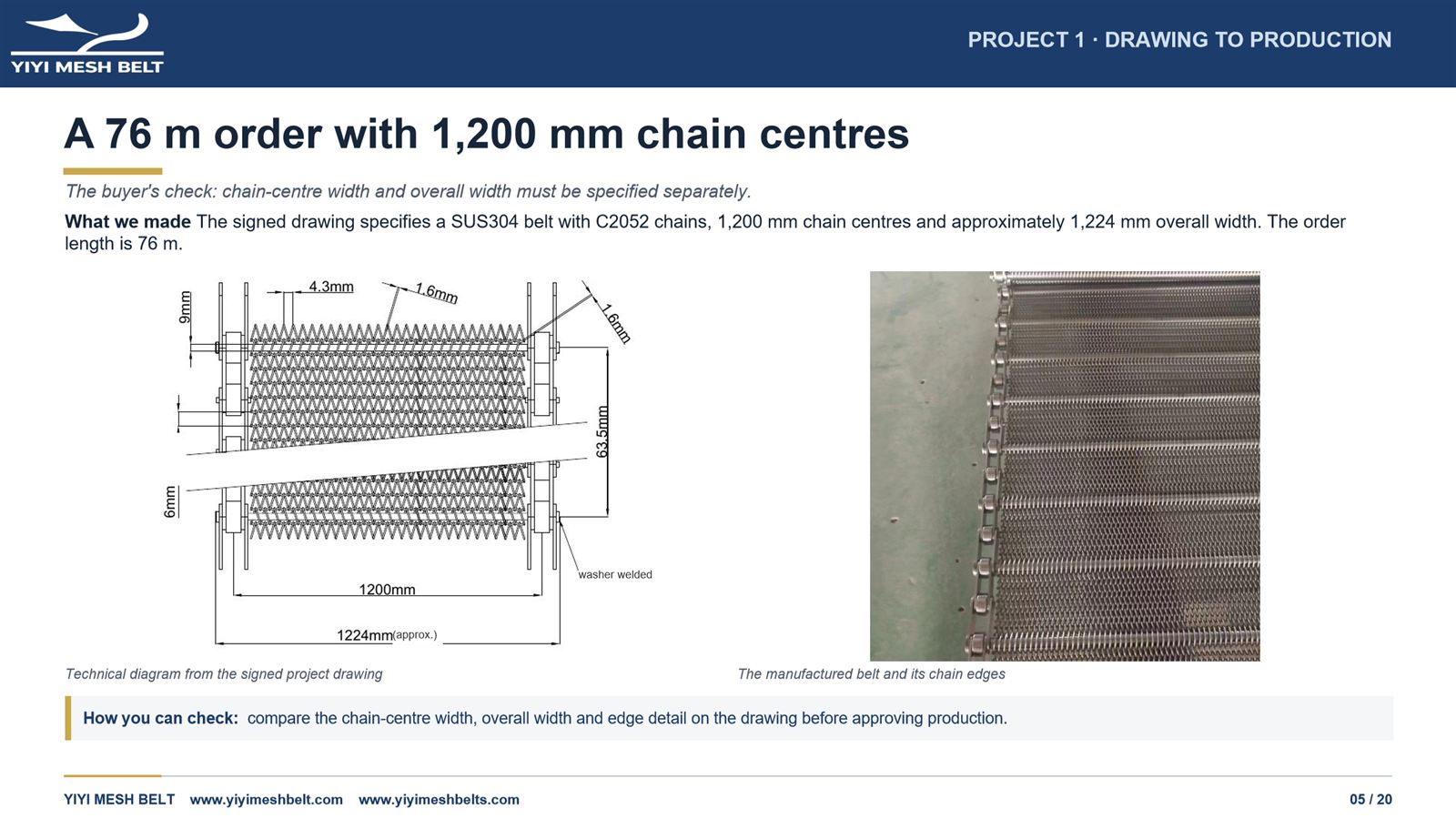
- Page 5 · A 76 m order with 1,200 mm chain centres
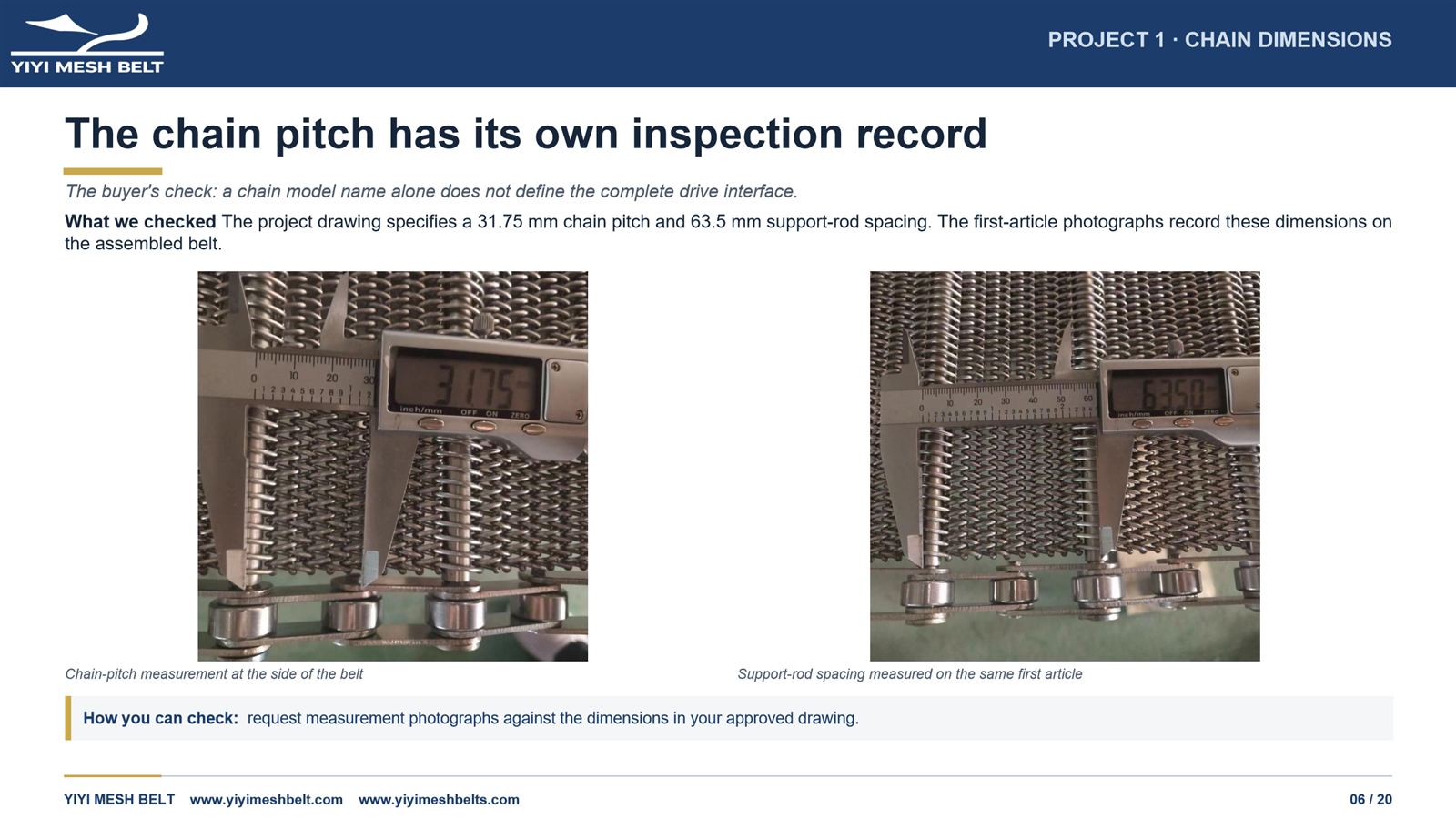
- Page 6 · The chain pitch has its own inspection record
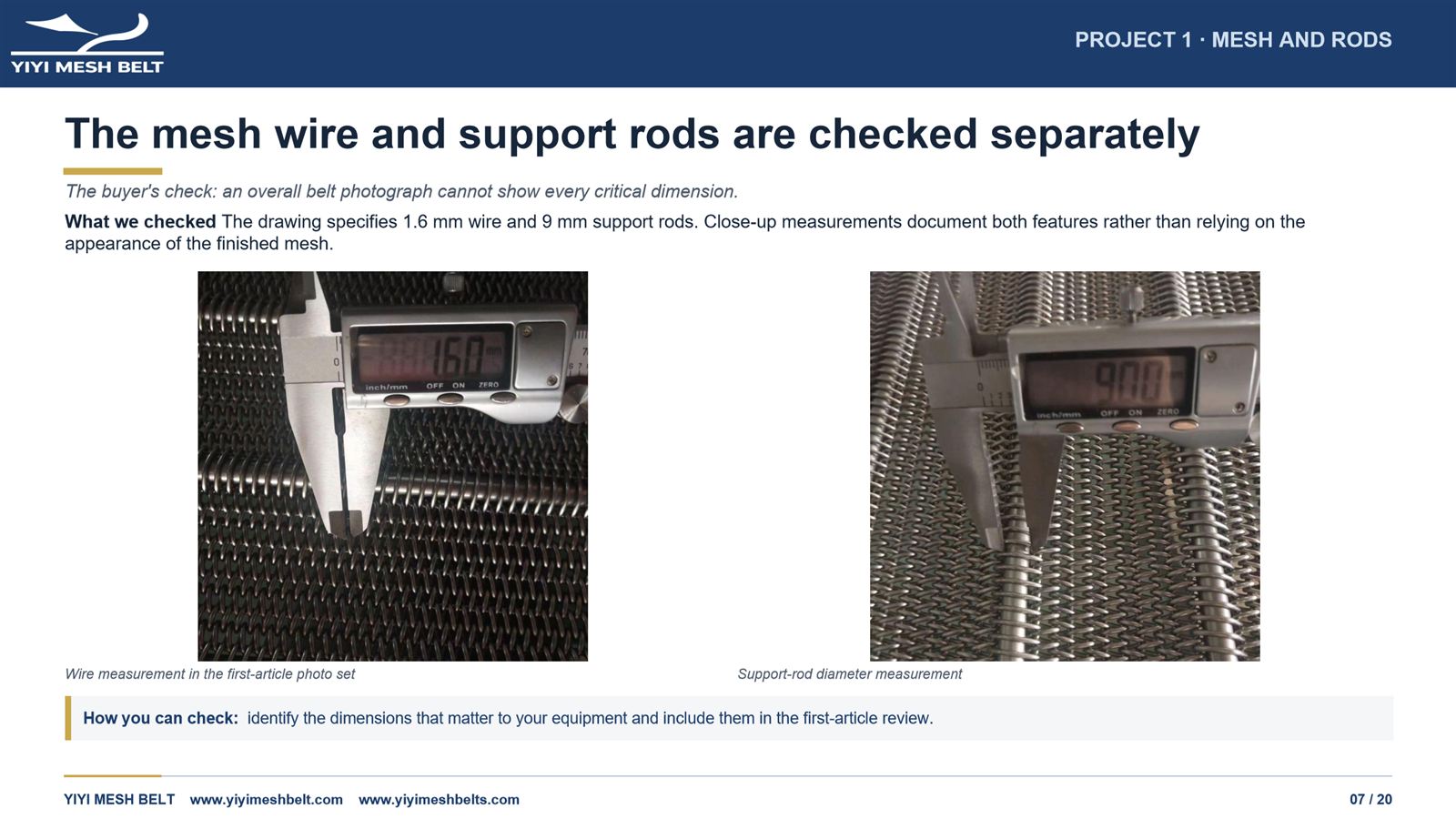
- Page 7 · The mesh wire and support rods are checked separately
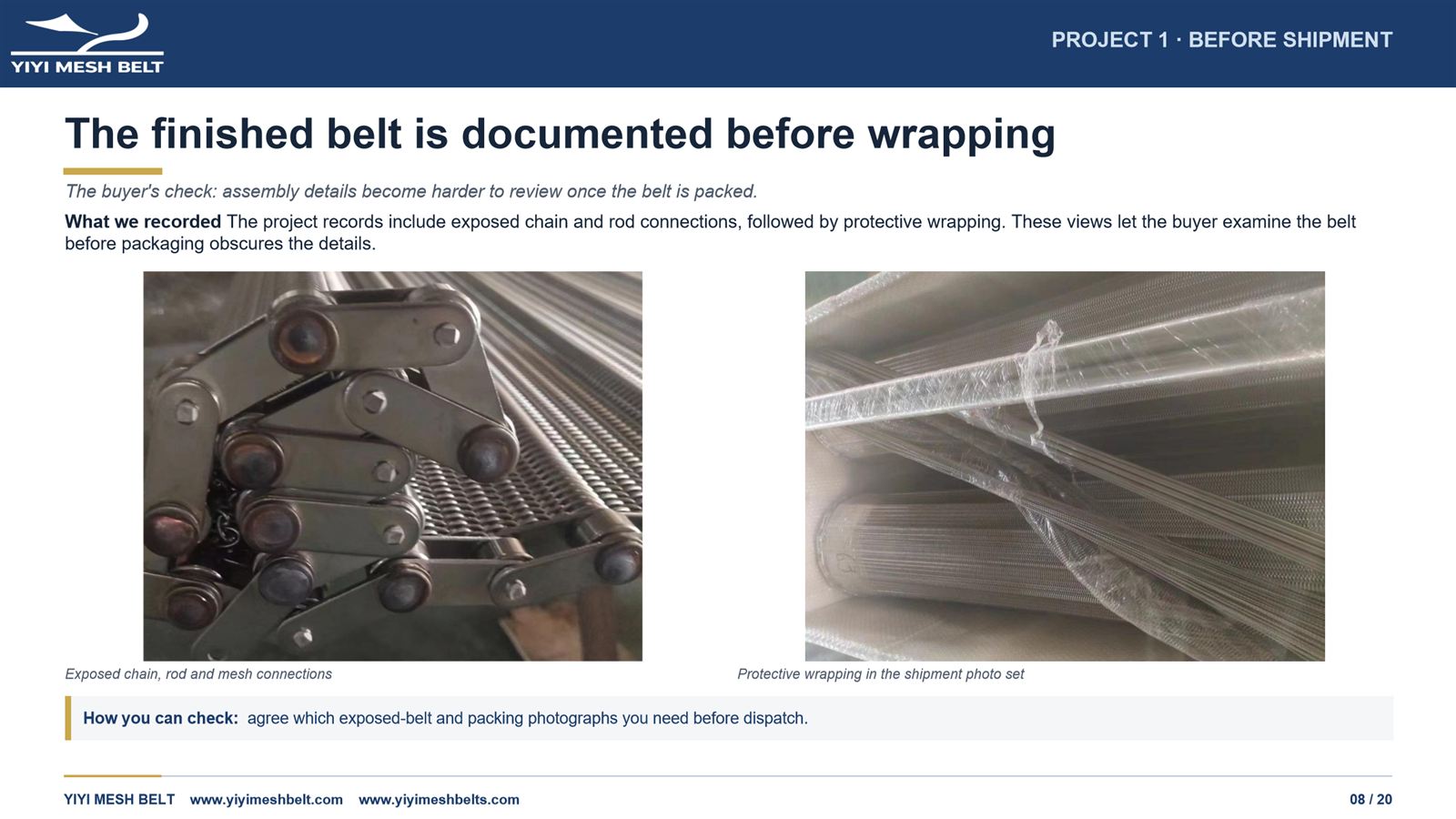
- Page 8 · The finished belt is documented before wrapping
- Page 9 · Three belt widths under one project
- Page 10 · Width checks distinguish the individual variants
- Page 11 · The 650 mm variant receives its own check
- Page 12 · Common specifications still need measured evidence
- Page 13 · Another 1,200 mm belt, with a new order record
- Page 14 · Width is recorded at first article and before dispatch
- Page 15 · The same dimension is visible at both stages
- Page 16 · A belt and sprockets supplied in one project
- Page 17 · Chain pitch and sprocket bore are separate checks
- Page 18 · Sprocket dimensions are recorded before supply
- Page 19 · The records your team can review before ordering
Text version of this document
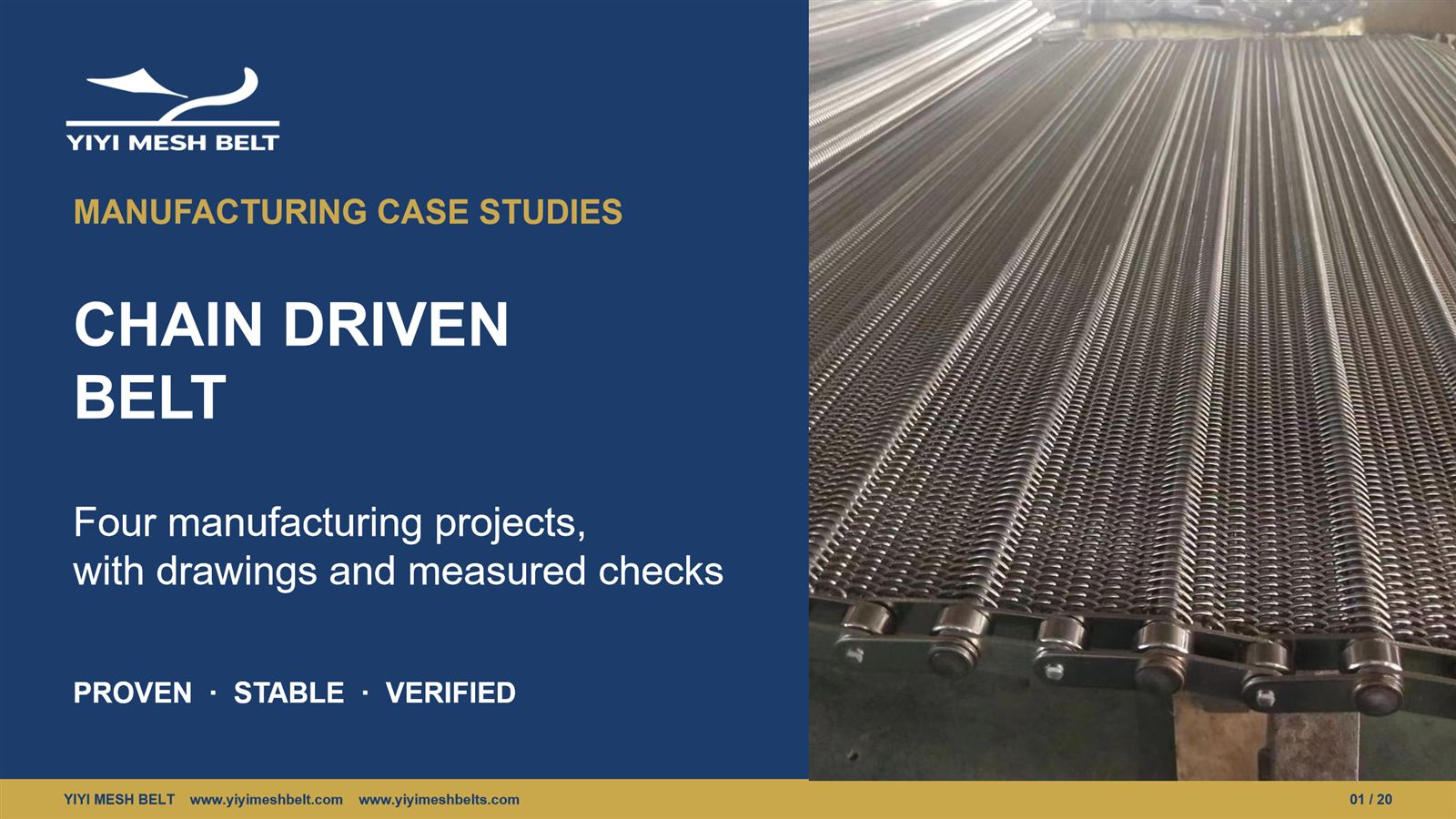
Page 1. MANUFACTURING CASE STUDIES CHAIN DRIVEN BELT Four manufacturing projects, with drawings and measured checks PROVEN · STABLE · VERIFIED
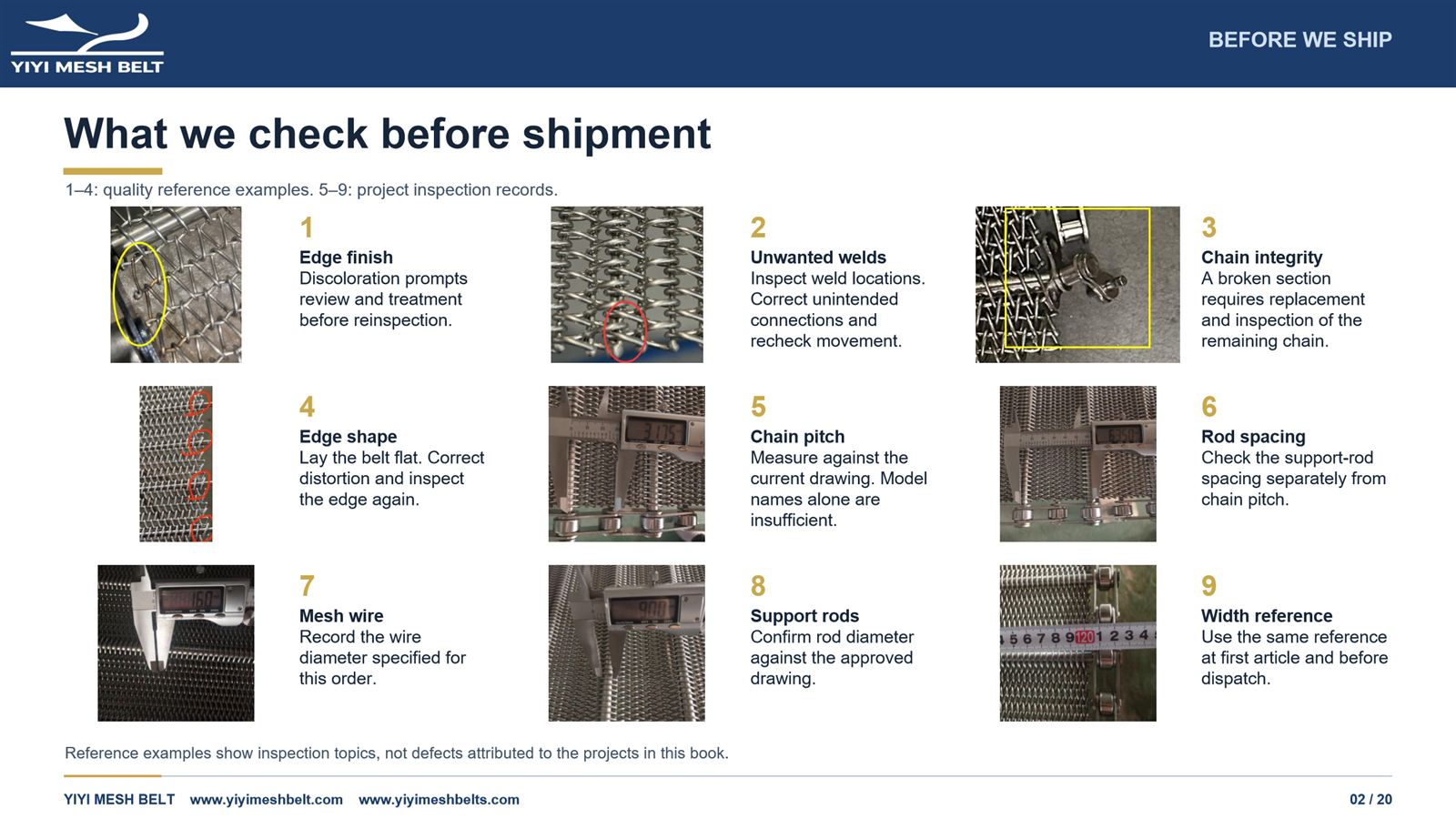
Page 2. BEFORE WE SHIP What we check before shipment 1 Edge finishDiscoloration prompts review and treatment before reinspection. 2 Unwanted weldsInspect weld locations. Correct unintended connections and recheck movement. 3 Chain integrityA broken section requires replacement and inspection of the remaining chain. 4 Edge shapeLay the belt flat. Correct distortion and inspect the edge again. 5 Chain pitchMeasure against the current drawing. Model names alone are insufficient. 6 Rod spacingCheck the support-rod spacing separately from chain pitch. 7 Mesh wireRecord the wire diameter specified for this order. 8 Support rodsConfirm rod diameter against the approved drawing. 9 Width referenceUse the same reference at first article and before dispatch. 1–4: quality reference examples. 5–9: project inspection records. Reference examples show inspection topics, not defects attributed to the projects in this book.
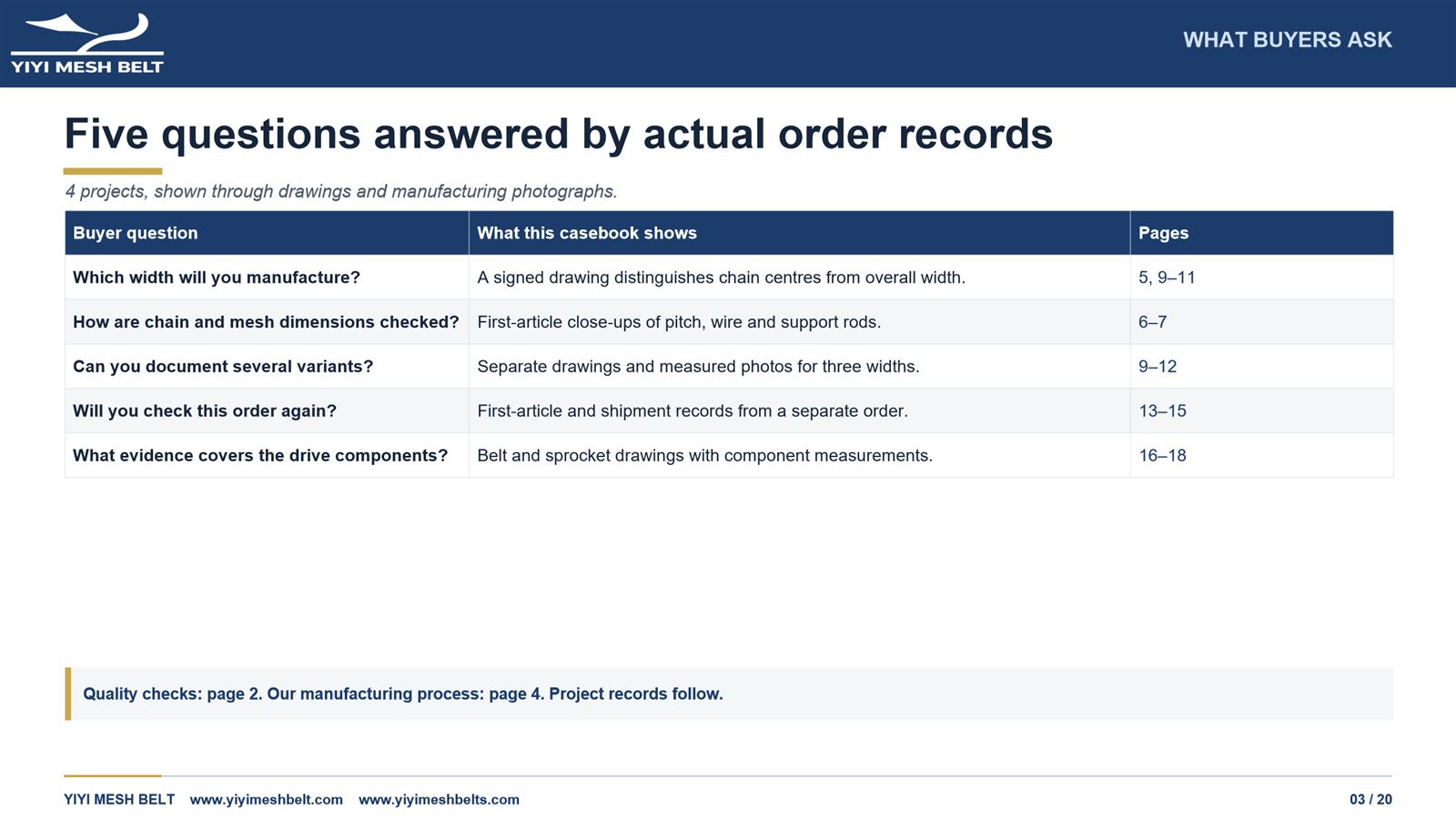
Page 3. WHAT BUYERS ASK Five questions answered by actual order records 4 projects, shown through drawings and manufacturing photographs. Buyer question What this casebook shows Pages Which width will you manufacture? A signed drawing distinguishes chain centres from overall width. 5, 9–11 How are chain and mesh dimensions checked? First-article close-ups of pitch, wire and support rods. 6–7 Can you document several variants? Separate drawings and measured photos for three widths. 9–12 Will you check this order again? First-article and shipment records from a separate order. 13–15 What evidence covers the drive components? Belt and sprocket drawings with component measurements. 16–18 Quality checks: page 2. Our manufacturing process: page 4. Project records follow.
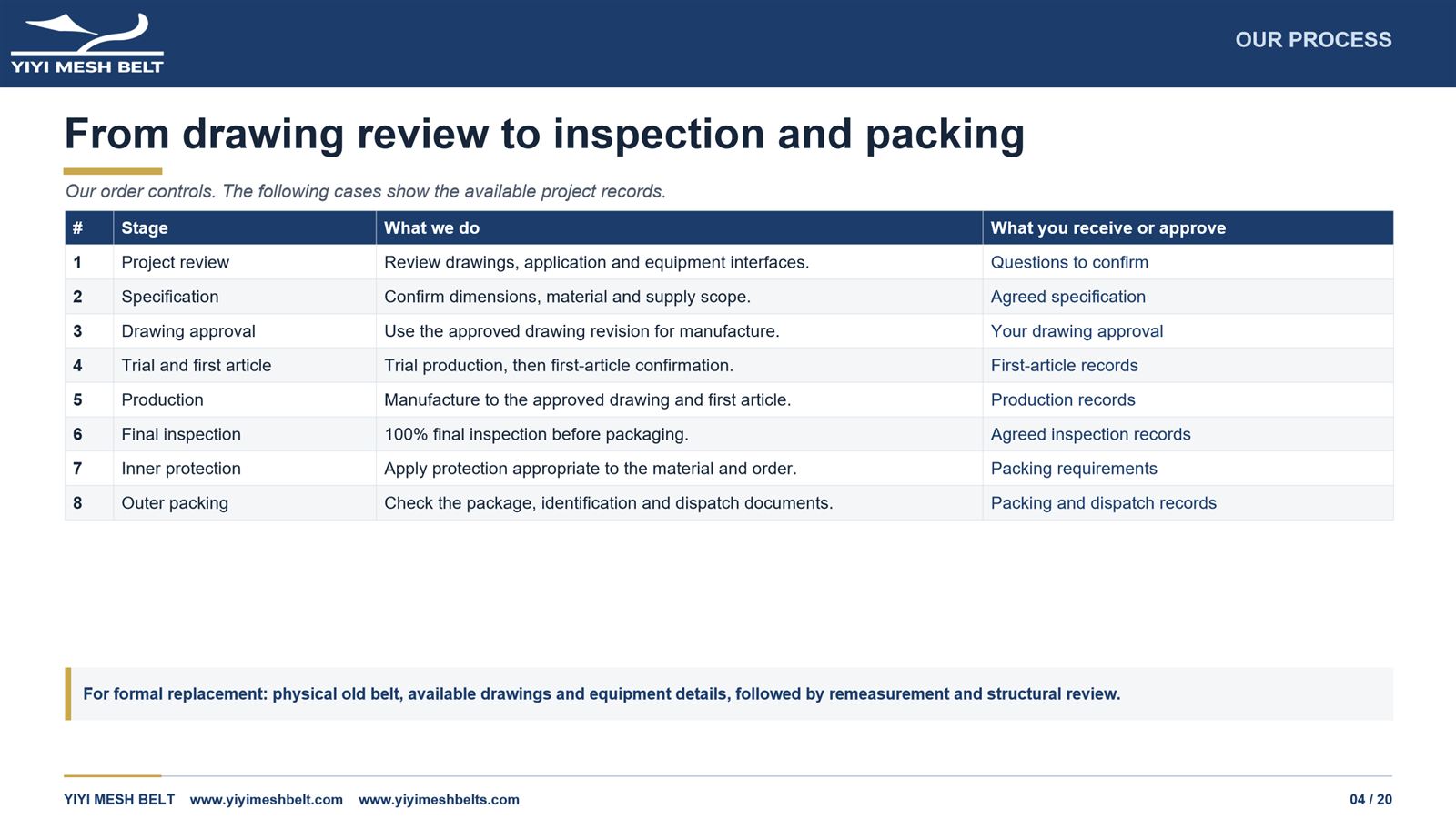
Page 4. OUR PROCESS From drawing review to inspection and packing Our order controls. The following cases show the available project records. # Stage What we do What you receive or approve 1 Project review Review drawings, application and equipment interfaces. Questions to confirm 2 Specification Confirm dimensions, material and supply scope. Agreed specification 3 Drawing approval Use the approved drawing revision for manufacture. Your drawing approval 4 Trial and first article Trial production, then first-article confirmation. First-article records 5 Production Manufacture to the approved drawing and first article. Production records 6 Final inspection 100% final inspection before packaging. Agreed inspection records 7 Inner protection Apply protection appropriate to the material and order. Packing requirements 8 Outer packing Check the package, identification and dispatch documents. Packing and dispatch records For formal replacement: physical old belt, available drawings and equipment details, followed by remeasurement and structural review.
Page 5. PROJECT 1 · DRAWING TO PRODUCTION A 76 m order with 1,200 mm chain centres The buyer's check: chain-centre width and overall width must be specified separately. What we made The signed drawing specifies a SUS304 belt with C2052 chains, 1,200 mm chain centres and approximately 1,224 mm overall width. The order length is 76 m. Technical diagram from the signed project drawing The manufactured belt and its chain edges How you can check: compare the chain-centre width, overall width and edge detail on the drawing before approving production. washer welded (approx.)
Page 6. PROJECT 1 · CHAIN DIMENSIONS The chain pitch has its own inspection record The buyer's check: a chain model name alone does not define the complete drive interface. What we checked The project drawing specifies a 31.75 mm chain pitch and 63.5 mm support-rod spacing. The first-article photographs record these dimensions on the assembled belt. Chain-pitch measurement at the side of the belt Support-rod spacing measured on the same first article How you can check: request measurement photographs against the dimensions in your approved drawing.
Page 7. PROJECT 1 · MESH AND RODS The mesh wire and support rods are checked separately The buyer's check: an overall belt photograph cannot show every critical dimension. What we checked The drawing specifies 1.6 mm wire and 9 mm support rods. Close-up measurements document both features rather than relying on the appearance of the finished mesh. Wire measurement in the first-article photo set Support-rod diameter measurement How you can check: identify the dimensions that matter to your equipment and include them in the first-article review.
Page 8. PROJECT 1 · BEFORE SHIPMENT The finished belt is documented before wrapping The buyer's check: assembly details become harder to review once the belt is packed. What we recorded The project records include exposed chain and rod connections, followed by protective wrapping. These views let the buyer examine the belt before packaging obscures the details. Exposed chain, rod and mesh connections Protective wrapping in the shipment photo set How you can check: agree which exposed-belt and packing photographs you need before dispatch.
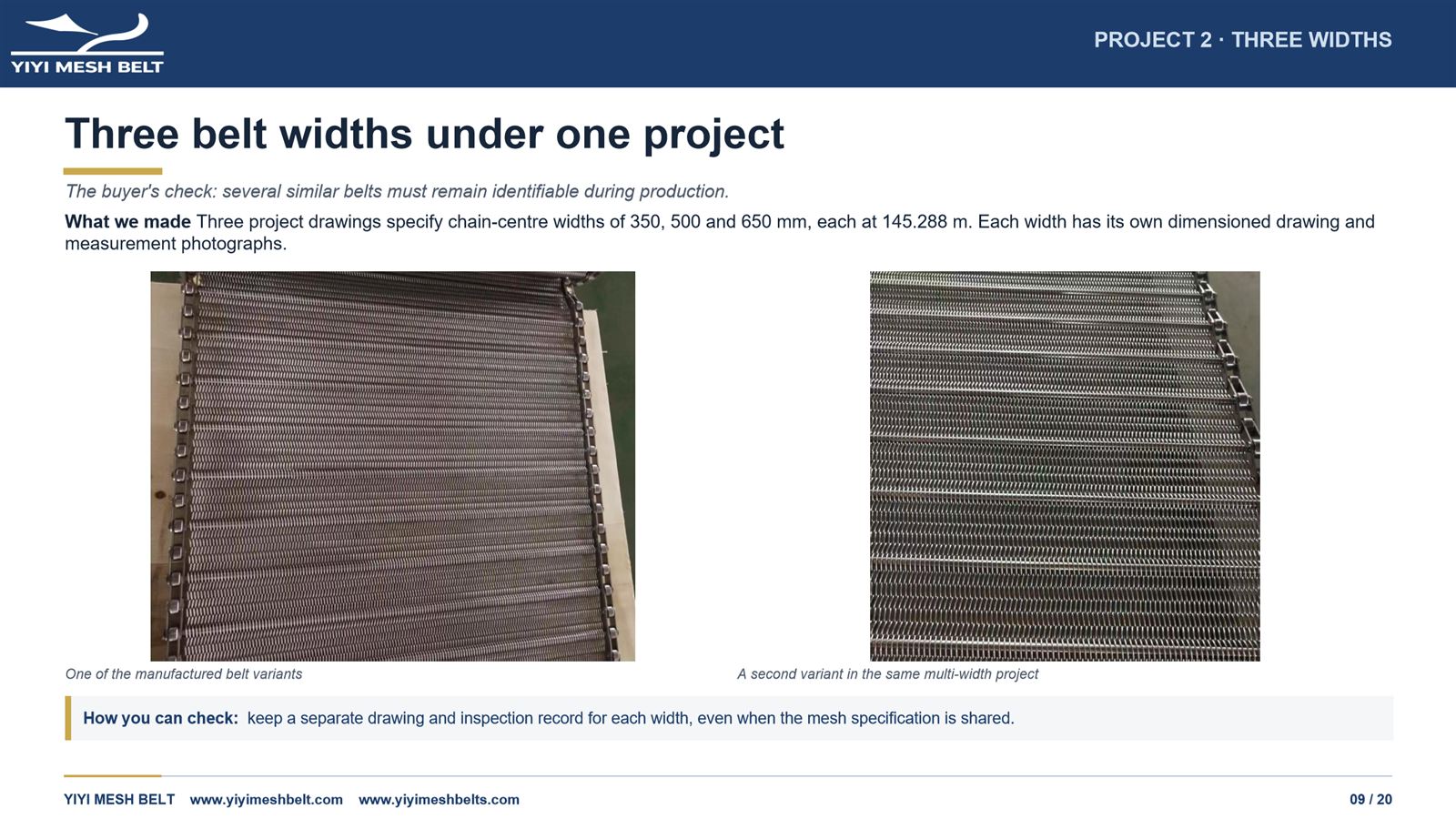
Page 9. PROJECT 2 · THREE WIDTHS Three belt widths under one project The buyer's check: several similar belts must remain identifiable during production. What we made Three project drawings specify chain-centre widths of 350, 500 and 650 mm, each at 145.288 m. Each width has its own dimensioned drawing and measurement photographs. One of the manufactured belt variants A second variant in the same multi-width project How you can check: keep a separate drawing and inspection record for each width, even when the mesh specification is shared.
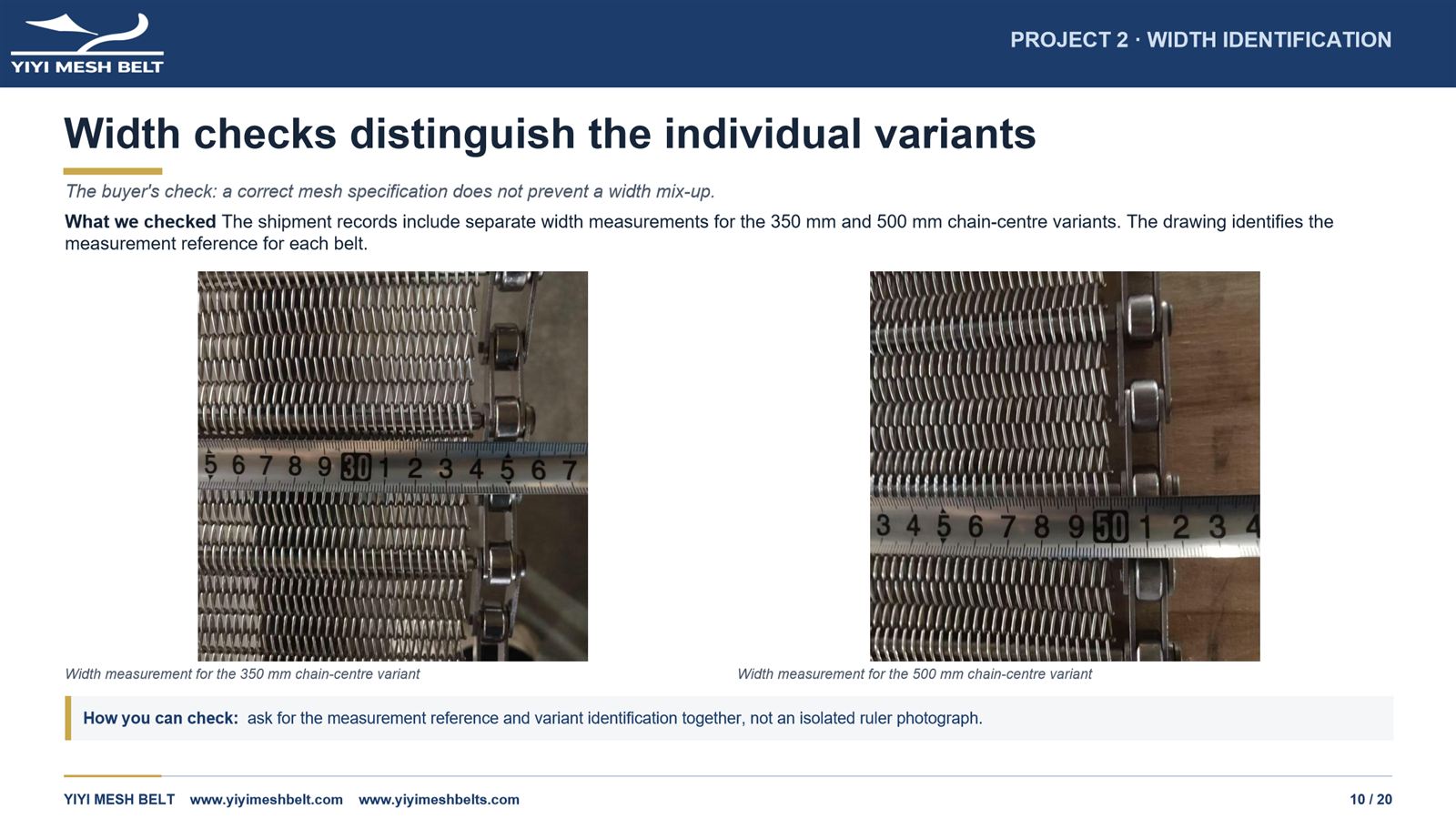
Page 10. PROJECT 2 · WIDTH IDENTIFICATION Width checks distinguish the individual variants The buyer's check: a correct mesh specification does not prevent a width mix-up. What we checked The shipment records include separate width measurements for the 350 mm and 500 mm chain-centre variants. The drawing identifies the measurement reference for each belt. Width measurement for the 350 mm chain-centre variant Width measurement for the 500 mm chain-centre variant How you can check: ask for the measurement reference and variant identification together, not an isolated ruler photograph.
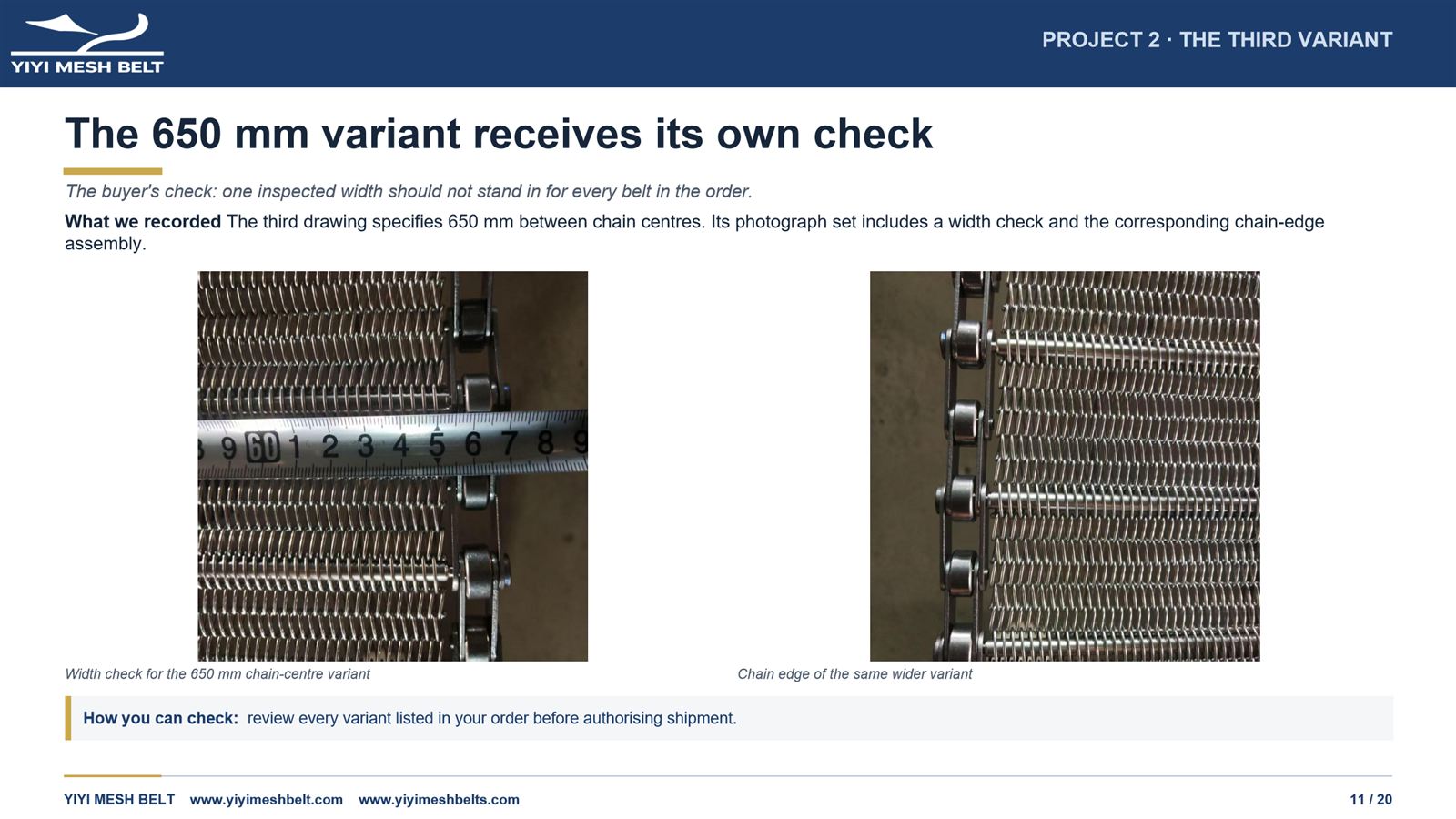
Page 11. PROJECT 2 · THE THIRD VARIANT The 650 mm variant receives its own check The buyer's check: one inspected width should not stand in for every belt in the order. What we recorded The third drawing specifies 650 mm between chain centres. Its photograph set includes a width check and the corresponding chain-edge assembly. Width check for the 650 mm chain-centre variant Chain edge of the same wider variant How you can check: review every variant listed in your order before authorising shipment.
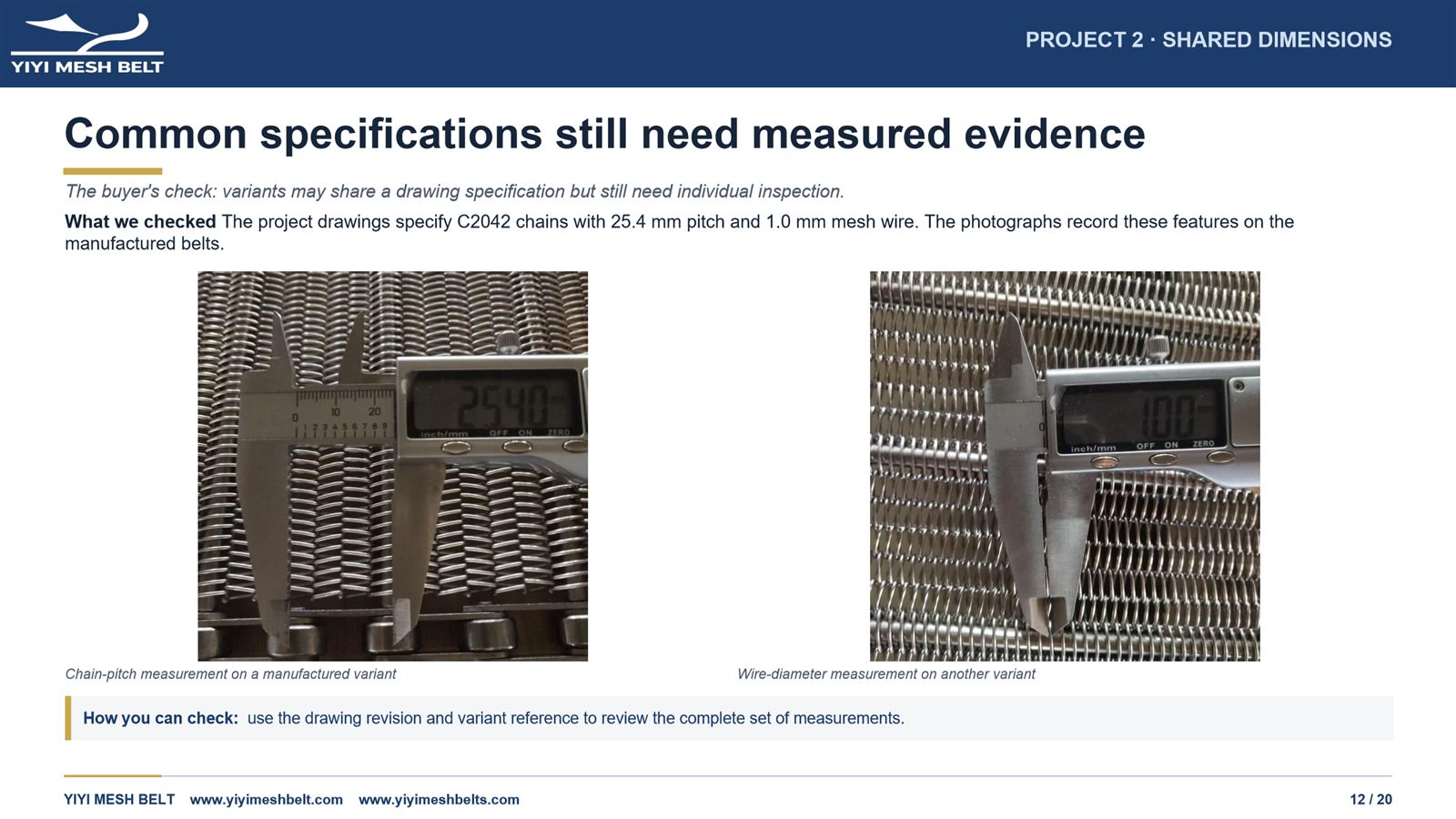
Page 12. PROJECT 2 · SHARED DIMENSIONS Common specifications still need measured evidence The buyer's check: variants may share a drawing specification but still need individual inspection. What we checked The project drawings specify C2042 chains with 25.4 mm pitch and 1.0 mm mesh wire. The photographs record these features on the manufactured belts. Chain-pitch measurement on a manufactured variant Wire-diameter measurement on another variant How you can check: use the drawing revision and variant reference to review the complete set of measurements.
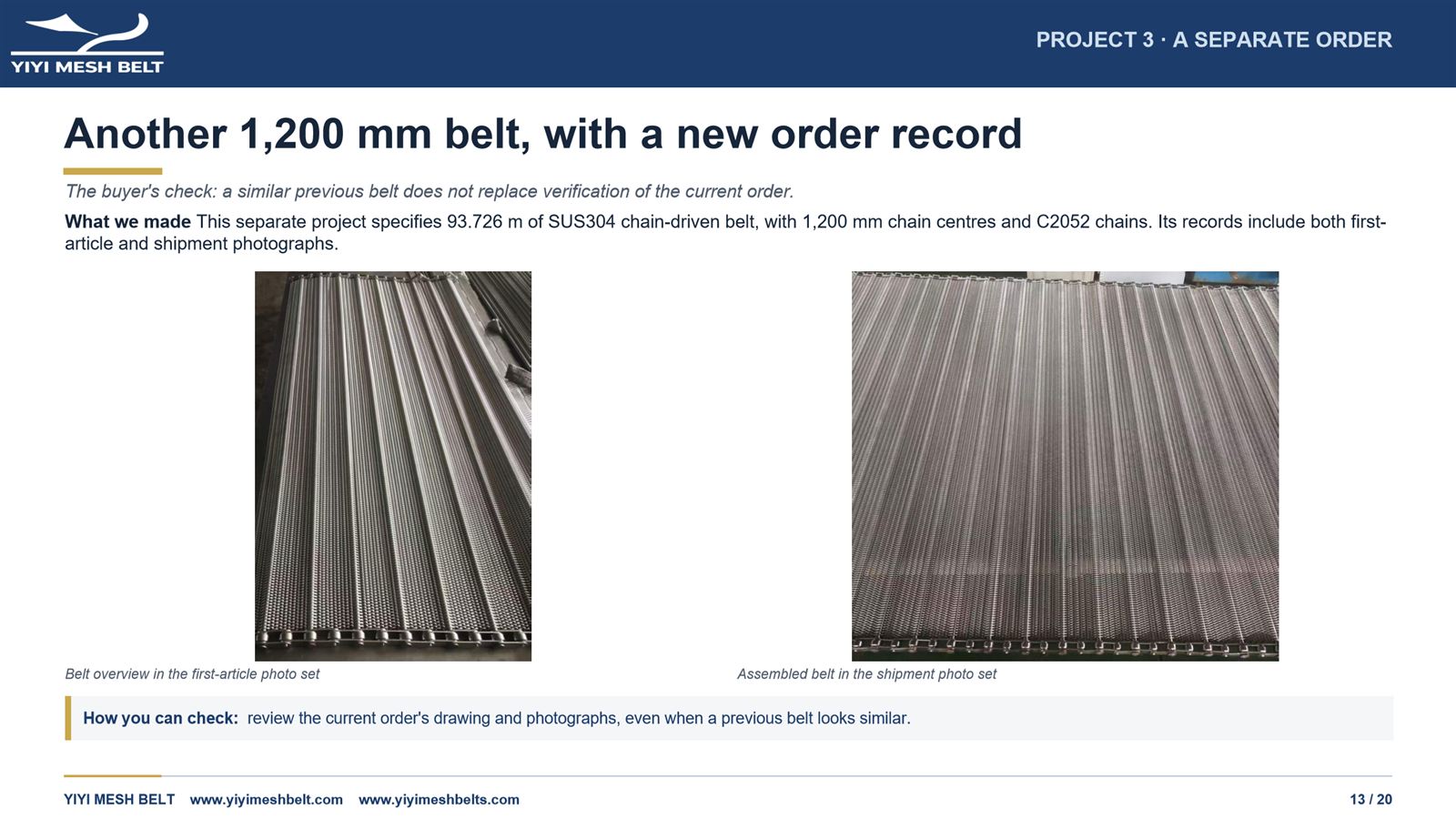
Page 13. PROJECT 3 · A SEPARATE ORDER Another 1,200 mm belt, with a new order record The buyer's check: a similar previous belt does not replace verification of the current order. What we made This separate project specifies 93.726 m of SUS304 chain-driven belt, with 1,200 mm chain centres and C2052 chains. Its records include both first-article and shipment photographs. Belt overview in the first-article photo set Assembled belt in the shipment photo set How you can check: review the current order's drawing and photographs, even when a previous belt looks similar.
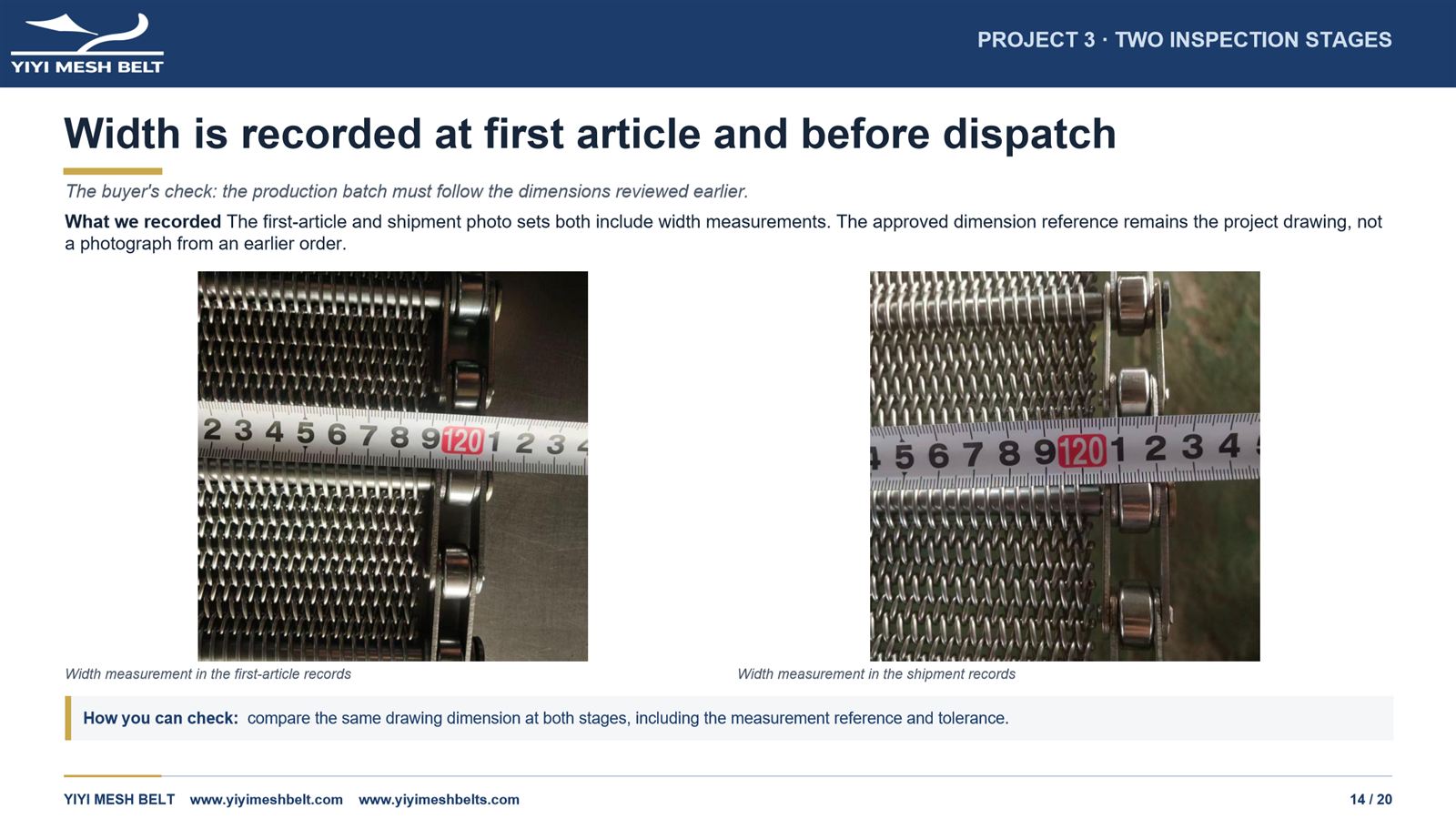
Page 14. PROJECT 3 · TWO INSPECTION STAGES Width is recorded at first article and before dispatch The buyer's check: the production batch must follow the dimensions reviewed earlier. What we recorded The first-article and shipment photo sets both include width measurements. The approved dimension reference remains the project drawing, not a photograph from an earlier order. Width measurement in the first-article records Width measurement in the shipment records How you can check: compare the same drawing dimension at both stages, including the measurement reference and tolerance.
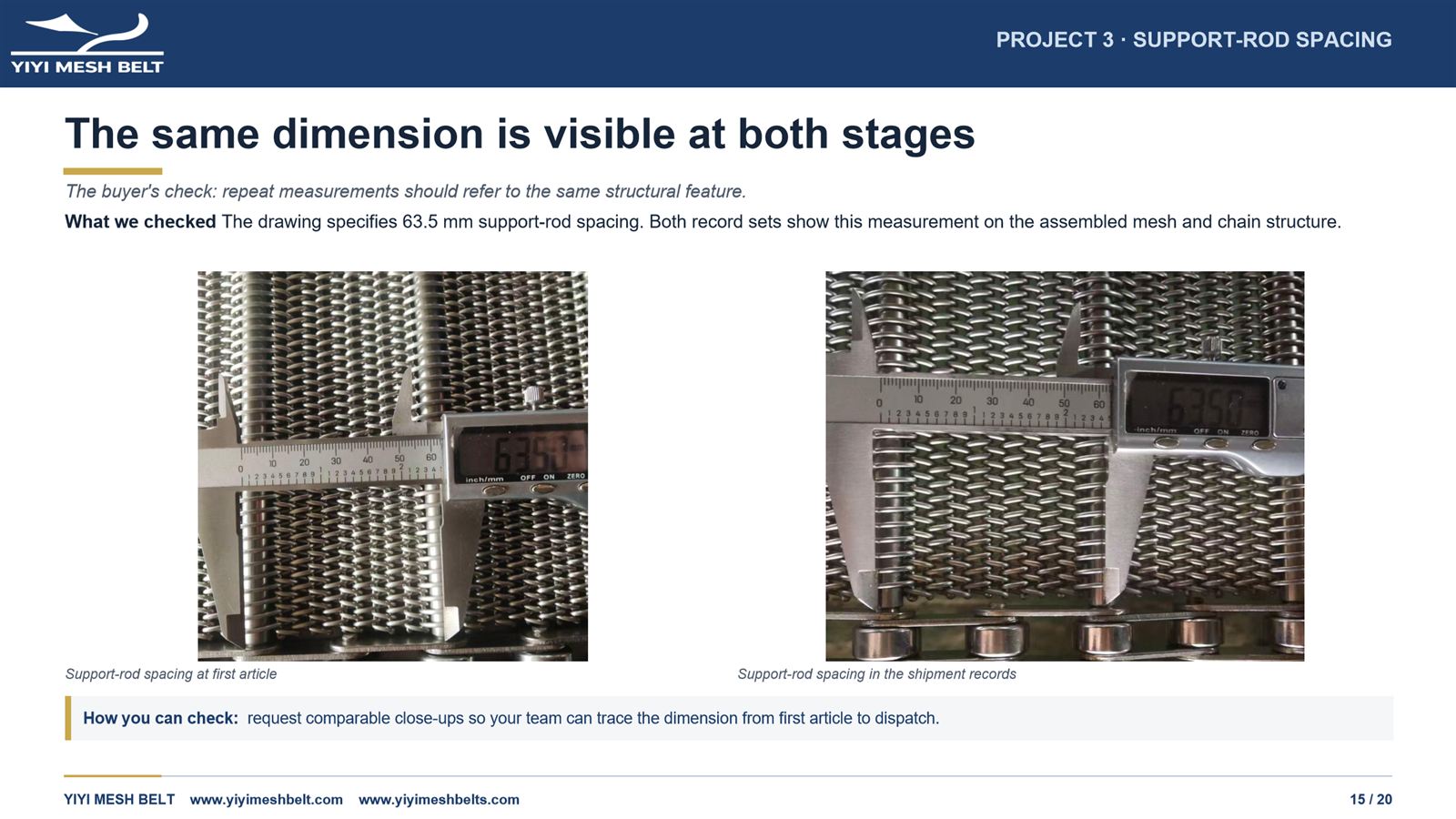
Page 15. PROJECT 3 · SUPPORT-ROD SPACING The same dimension is visible at both stages The buyer's check: repeat measurements should refer to the same structural feature. What we checked The drawing specifies 63.5 mm support-rod spacing. Both record sets show this measurement on the assembled mesh and chain structure. Support-rod spacing at first article Support-rod spacing in the shipment records How you can check: request comparable close-ups so your team can trace the dimension from first article to dispatch.
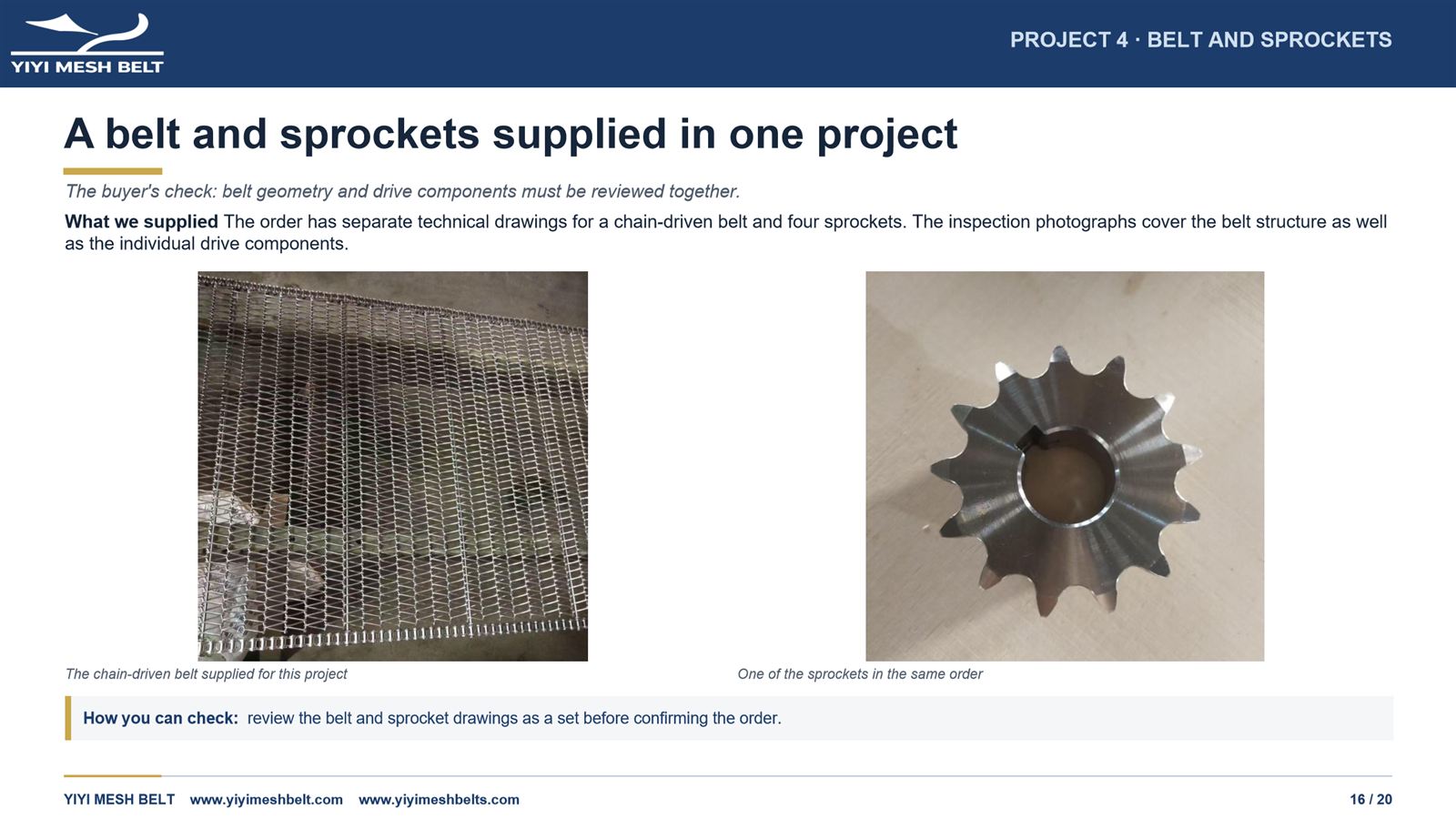
Page 16. PROJECT 4 · BELT AND SPROCKETS A belt and sprockets supplied in one project The buyer's check: belt geometry and drive components must be reviewed together. What we supplied The order has separate technical drawings for a chain-driven belt and four sprockets. The inspection photographs cover the belt structure as well as the individual drive components. The chain-driven belt supplied for this project One of the sprockets in the same order How you can check: review the belt and sprocket drawings as a set before confirming the order.
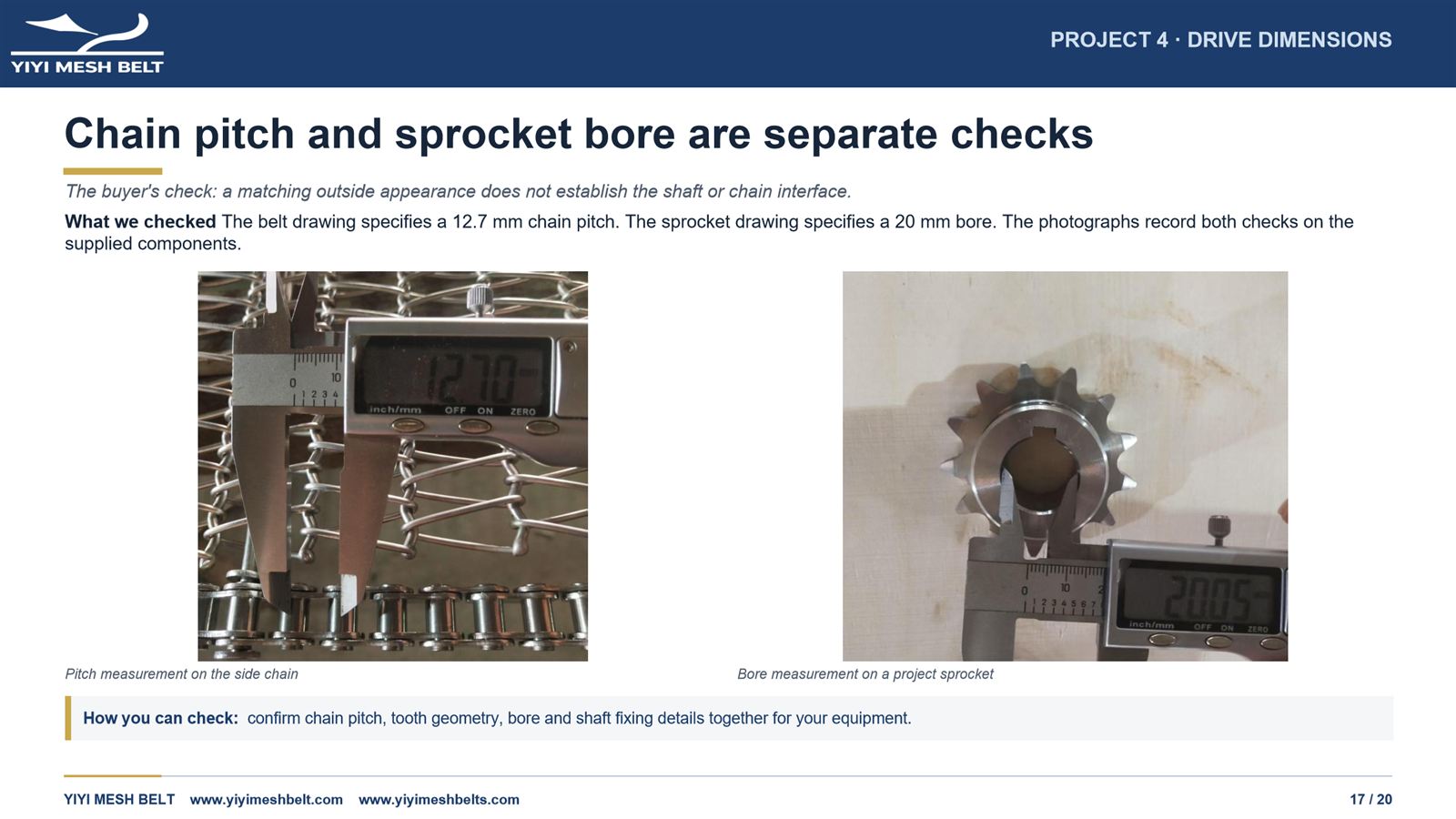
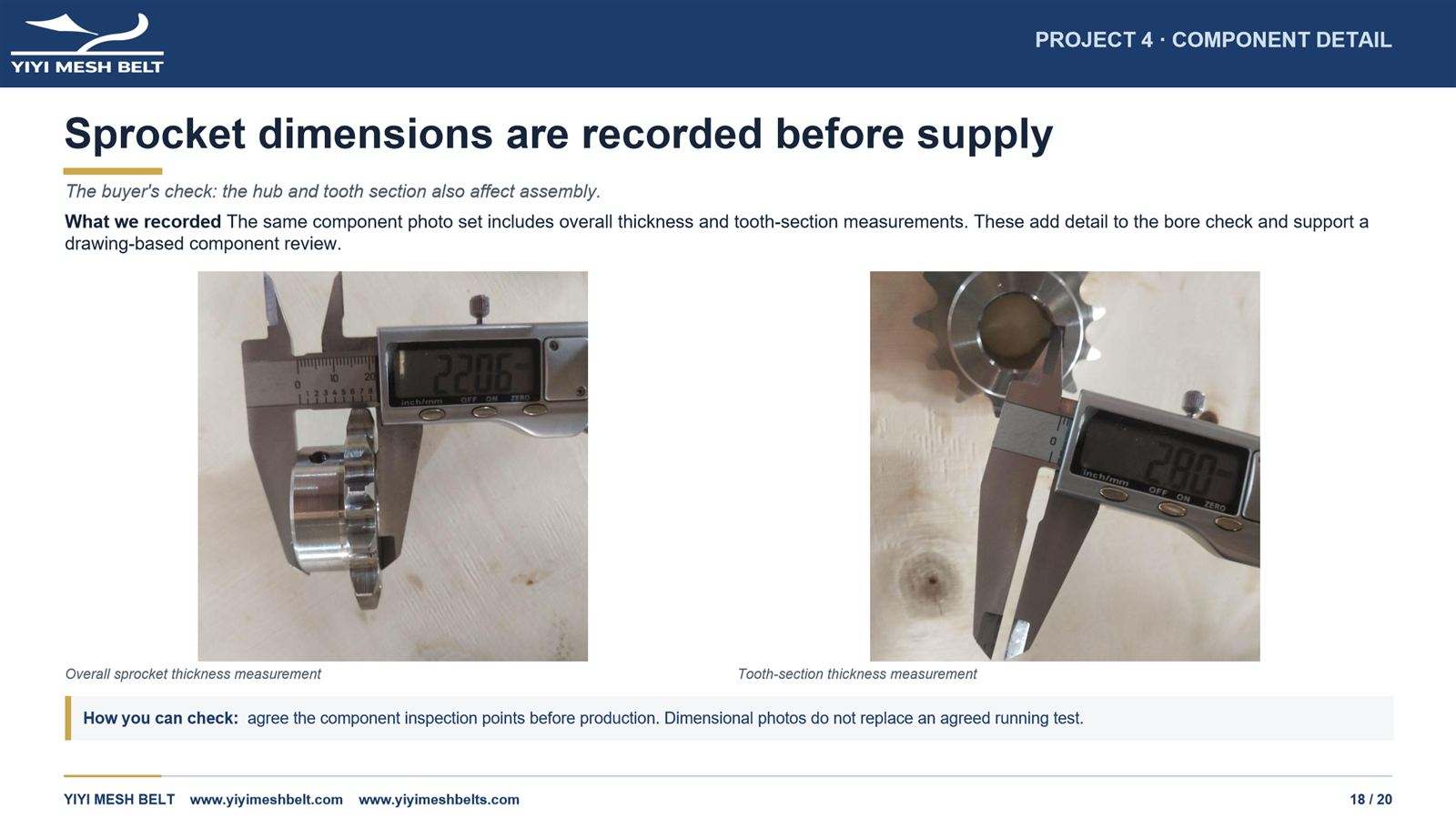
Page 17. PROJECT 4 · DRIVE DIMENSIONS Chain pitch and sprocket bore are separate checks The buyer's check: a matching outside appearance does not establish the shaft or chain interface. What we checked The belt drawing specifies a 12.7 mm chain pitch. The sprocket drawing specifies a 20 mm bore. The photographs record both checks on the supplied components. Pitch measurement on the side chain Bore measurement on a project sprocket How you can check: confirm chain pitch, tooth geometry, bore and shaft fixing details together for your equipment.
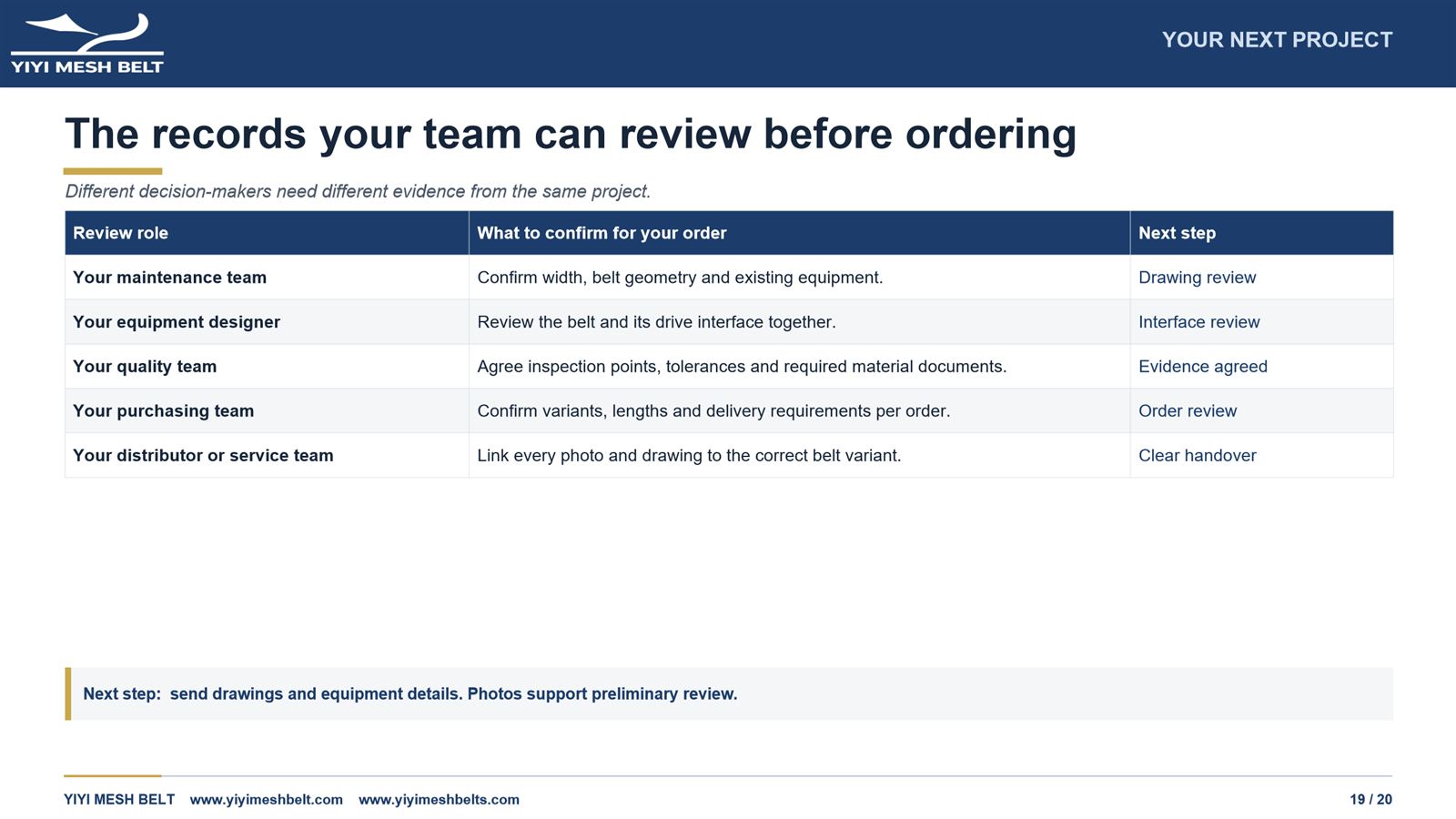
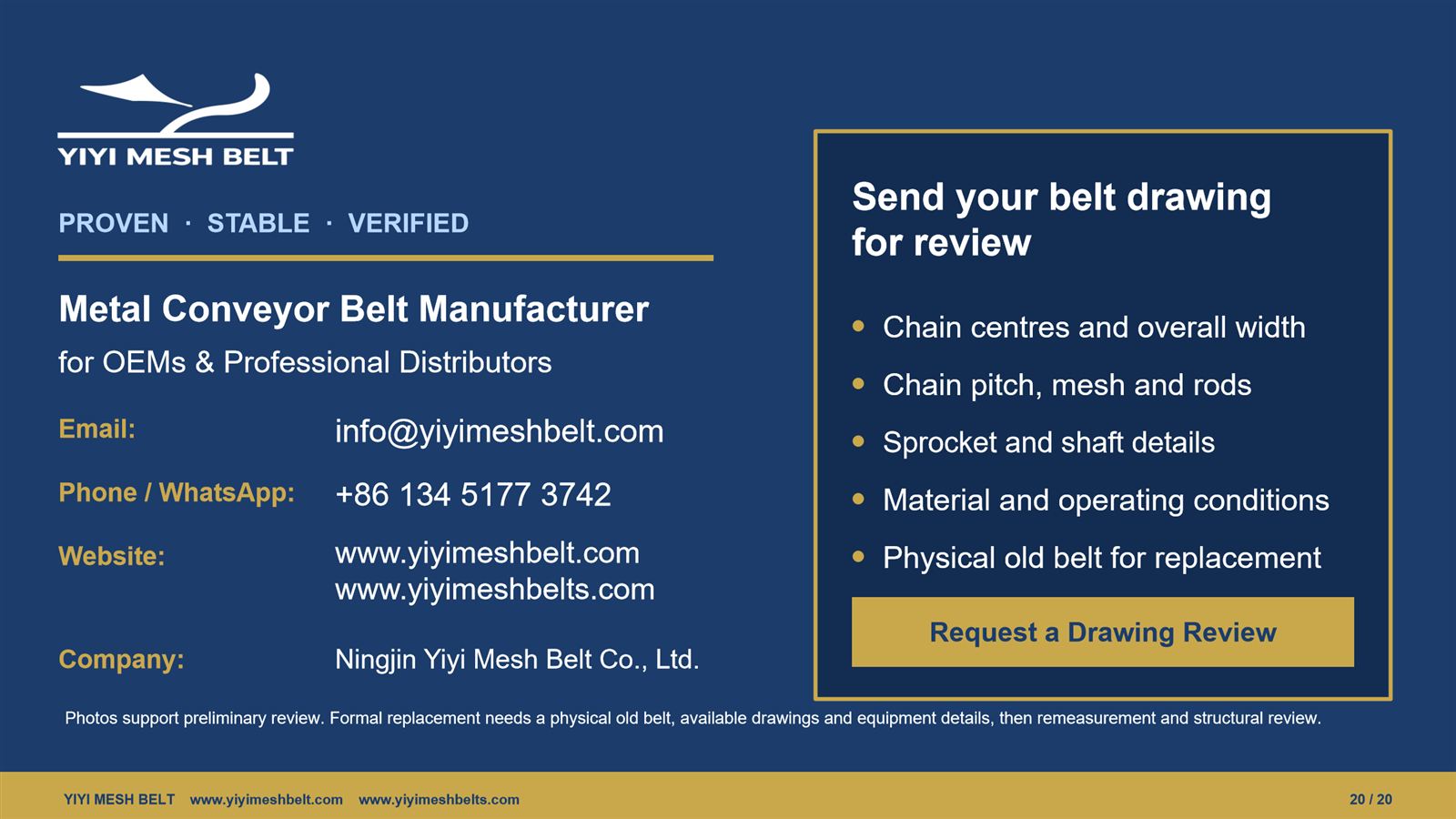
Page 18. PROJECT 4 · COMPONENT DETAIL Sprocket dimensions are recorded before supply The buyer's check: the hub and tooth section also affect assembly. What we recorded The same component photo set includes overall thickness and tooth-section measurements. These add detail to the bore check and support a drawing-based component review. Overall sprocket thickness measurement Tooth-section thickness measurement How you can check: agree the component inspection points before production. Dimensional photos do not replace an agreed running test.
Page 19. YOUR NEXT PROJECT The records your team can review before ordering Different decision-makers need different evidence from the same project. Review role What to confirm for your order Next step Your maintenance team Confirm width, belt geometry and existing equipment. Drawing review Your equipment designer Review the belt and its drive interface together. Interface review Your quality team Agree inspection points, tolerances and required material documents. Evidence agreed Your purchasing team Confirm variants, lengths and delivery requirements per order. Order review Your distributor or service team Link every photo and drawing to the correct belt variant. Clear handover Next step: send drawings and equipment details. Photos support preliminary review.
Page 20. PROVEN · STABLE · VERIFIED Metal Conveyor Belt Manufacturer Email: info@yiyimeshbelt.com Phone / WhatsApp: +86 134 5177 3742 Website: www.yiyimeshbelt.com www.yiyimeshbelts.com Company: Ningjin Yiyi Mesh Belt Co., Ltd. Send your belt drawing for review Chain centres and overall width Chain pitch, mesh and rods Sprocket and shaft details Material and operating conditions Physical old belt for replacement Request a Drawing Review for OEMs & Professional Distributors Photos support preliminary review. Formal replacement needs a physical old belt, available drawings and equipment details, then remeasurement and structural review.