Standard or Heavy-Duty Self-Stacking Belt: Which Does Your Spiral Need?
Picking the belt construction by width alone is a common mistake. Rod size, guard height and reinforcement decide how the stack carries its load.

Short answer
YIYI Mesh Belt builds the Self-Stacking Belt in three constructions. Standard uses 5 mm rods and widths up to 760 mm. Heavy duty uses 6 or 7 mm rods, widths of 660, 760 or 1069 mm and taller guards. Reinforced heavy duty adds 4 × 15 mm reinforcement pieces to 7 mm rods.
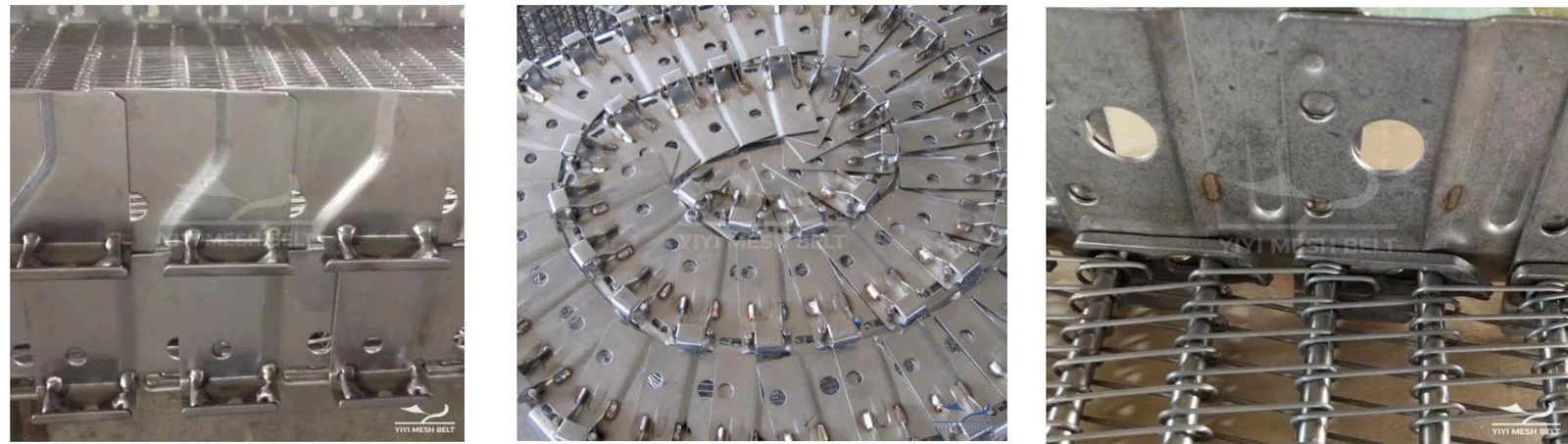
I am Sunny Ye, Global Sales Director at YIYI MESH BELT in Ningjin, Shandong, China. Our manufacturing experience dates back to 1998, and we build all three constructions to the drawing the customer approves. This is how I help freezer builders and distributors choose between them.
At a glance
| Product | Self-Stacking Belt in SUS304 or SUS316, standard, heavy-duty or reinforced heavy-duty construction |
|---|---|
| Application | Self-stacking spiral freezers, coolers and proofers in food processing |
| Key parameters to confirm | Belt width, rod diameter, side-guard height, usable tier clearance, product load, turn ratio, drive interface |
| Buyer type | Spiral freezer OEMs, food plant engineers, belt distributors |
| What to send for a quote | Equipment drawing or old belt sample, belt width, product height and load, tier count, cleaning method |
What is the difference between standard and heavy-duty?
The difference sits in the rods, the guards and the widths.
A standard self-stacking belt uses 5 mm rods, guards from 60 to 120 mm and widths from 420 to 760 mm. A heavy-duty belt uses 6 or 7 mm rods, guards of 80, 100 or 150 mm and widths of 660, 760 or 1069 mm. Spiral pitch, rod pitch and guard thickness stay the same.
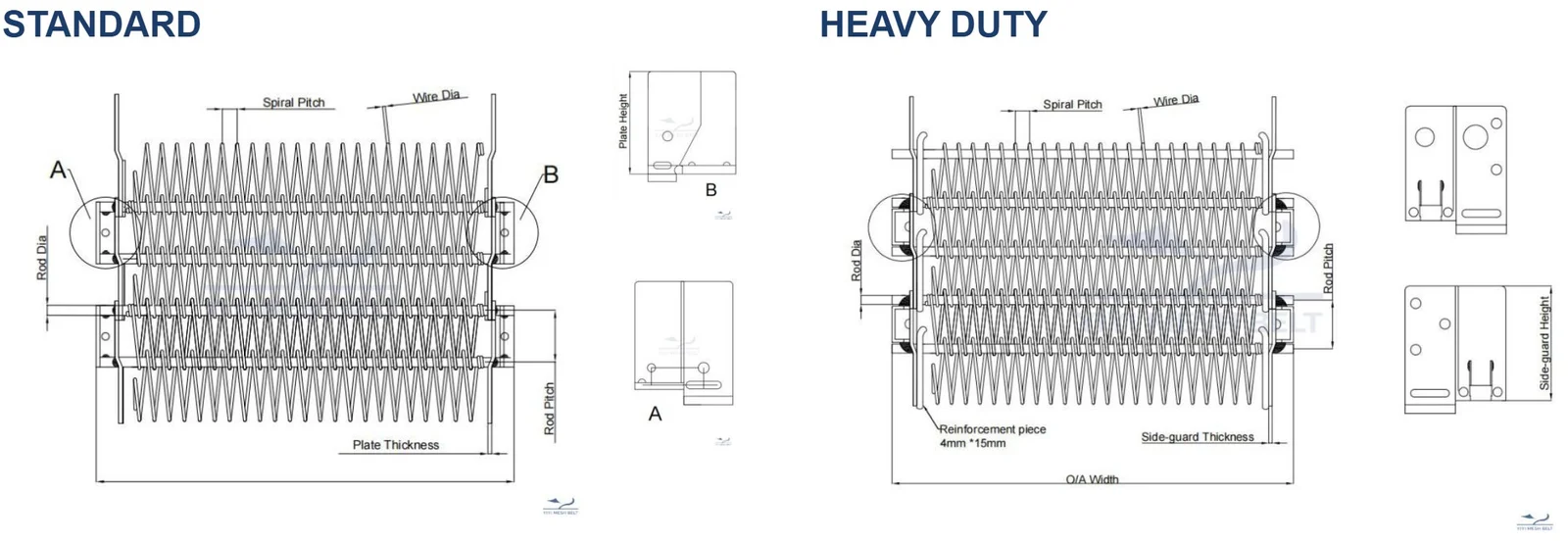
In my experience, buyers often ask for "the strong one" without knowing what changes. The heavy-duty belt is not a different belt family. It keeps the same spiral and rod pitch, so the mesh surface looks almost the same. What changes is the rod that carries the load across the width, and the guard that carries the tier above.
| Parameter | Standard | Heavy duty | Reinforced heavy duty |
|---|---|---|---|
| Rod diameter (mm / in) | 5 / 0.197 | 6 or 7 / 0.236 or 0.276 | 7 / 0.276 |
| Reinforcement piece (mm / in) | None | None | 4 × 15 / 0.157 × 0.591 |
| Side-guard height (mm) | 60 / 80 / 90 / 100 / 120 | 80 / 100 / 150 | 80 / 100 / 150 |
| Belt width (mm) | 420 / 580 / 640 / 660 / 760 | 660 / 760 / 1069 | 660 / 760 / 1069 |
| Spiral pitch (mm) | 6 / 9 / 13 | 6 / 9 / 13 | 6 / 9 / 13 |
| Rod pitch (mm / in) | 30 / 1.181 | 30 / 1.181 | 30 / 1.181 |
| Side-guard thickness (mm / in) | 1.5 / 0.059 | 1.5 / 0.059 | 1.5 / 0.059 |
| Turn-ratio reference | 1.6 / 1.7 | Confirmed on the approved drawing | Confirmed on the approved drawing |
| Material | SUS304 / SUS316 | SUS304 / SUS316 | SUS304 / SUS316 |
| Finish | Pickling / electropolishing | Pickling / electropolishing | Pickling / electropolishing |
These values come from our published Self-Stacking Belt technical specification. They are configuration options. Inch values are rounded, and the approved metric drawing governs each belt.
When is the standard construction enough?
Most self-stacking freezers run well on the standard construction.
The standard construction is enough when the belt width is 760 mm or less, the product load is normal for the freezer design, and the guard height between 60 and 120 mm gives the product enough clearance. It also covers the 1.6 and 1.7 turn-ratio references.
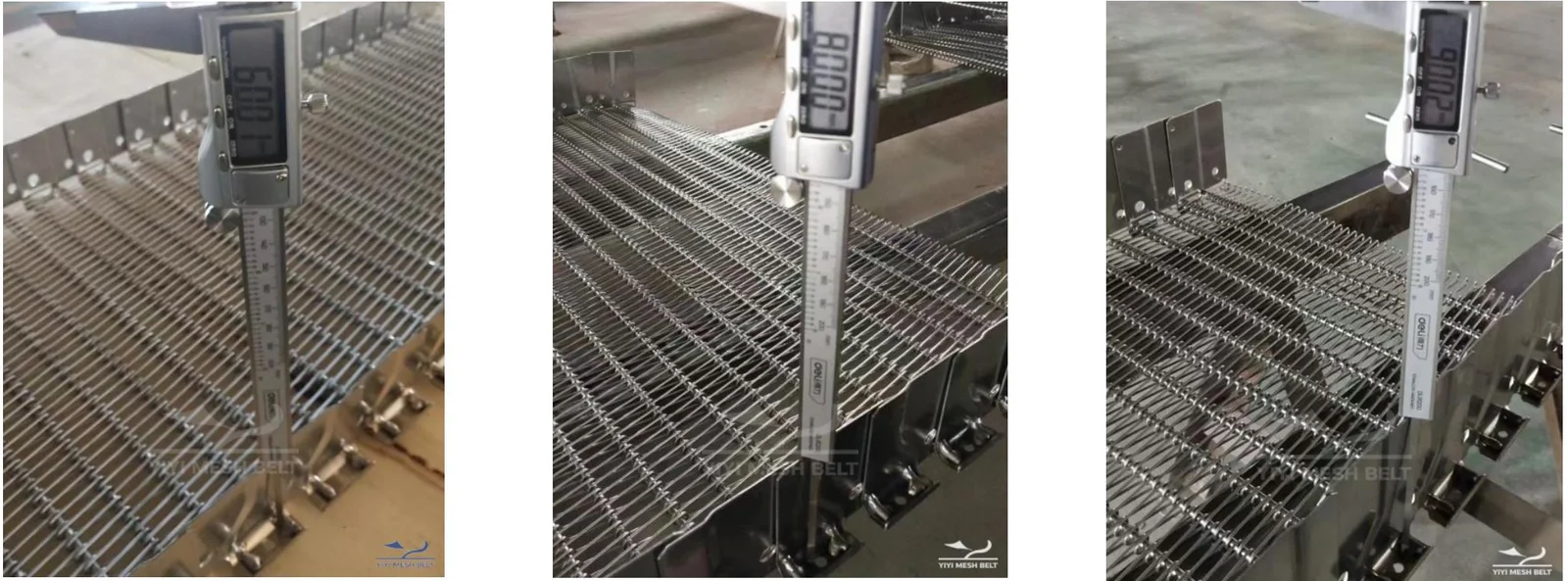
I start every selection with the standard construction and only move up when a figure pushes us there. A heavier belt is not automatically a better belt. It adds weight to every tier, and the freezer drive and frame must be designed for it.
The standard range gives five widths and five guard heights. That covers most compact freezers, coolers and proofers we see. If your freezer builder already specified a standard belt, keep it unless the product or the width has changed.
| Check | Standard fits when |
|---|---|
| Belt width | 420, 580, 640, 660 or 760 mm |
| Guard height | 60 to 120 mm gives the tallest product enough clearance |
| Turn ratio | The freezer design uses the 1.6 or 1.7 reference |
| Existing belt | The old belt has 5 mm rods and no reinforcement pieces |
When do you need heavy duty or reinforcement?
Heavy duty is for wider belts, taller guards and heavier stacks.
Choose heavy duty when the belt must be 1069 mm wide, when the product needs a 150 mm guard, or when the freezer design calls for 6 or 7 mm rods. Choose reinforced heavy duty when the drawing adds 4 × 15 mm reinforcement pieces to 7 mm rods. The equipment drawing makes the final call.
Width is the clearest trigger. A 1069 mm self-stacking belt is only built in the heavy-duty constructions. A 150 mm guard is also only available there. At 660 and 760 mm, both standard and heavy duty exist, so the freezer design and the old belt decide.
I never pick the reinforced version from a phone call. Reinforcement changes the guard structure, so we confirm it on the drawing or on a sample of the original belt. When a buyer replaces an existing heavy-duty belt, we copy the rod size and the reinforcement exactly.
| Trigger | What it means | Construction |
|---|---|---|
| Width 1069 mm | Outside the standard width range | Heavy duty or reinforced heavy duty |
| Guard 150 mm | Taller product clearance than the standard range | Heavy duty or reinforced heavy duty |
| 6 or 7 mm rods on the drawing | The freezer design specifies a heavier rod | Heavy duty |
| Reinforcement pieces on the old belt | The original belt was built reinforced | Reinforced heavy duty |
Is side-guard height the same as tier clearance?
No. This is the question I answer most often.
Side-guard height is a component dimension of the belt. Usable tier clearance is the space your product actually gets between tiers, and it depends on the equipment arrangement. A 100 mm guard does not mean a 100 mm product will fit, so we confirm clearance on the freezer drawing.
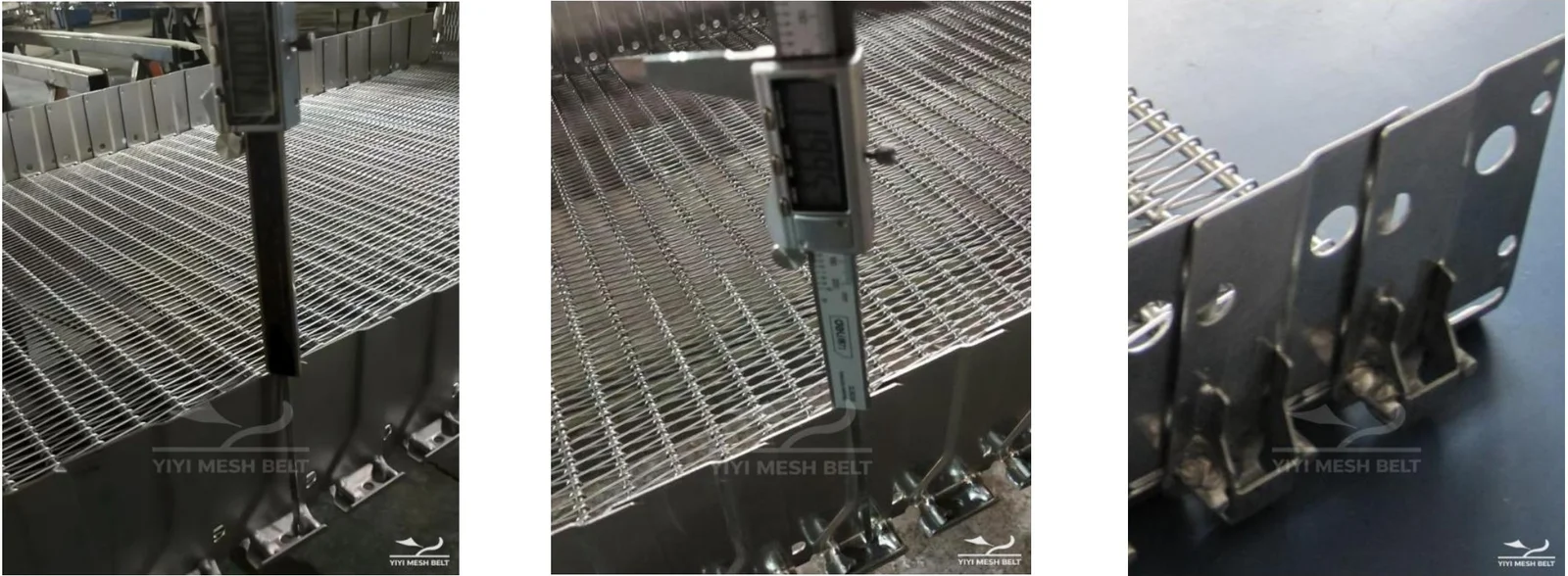
The guard height is what we measure on the belt. The tier clearance is what the product sees inside the freezer. The mesh thickness, the way the guards nest and the freezer design all sit between those two figures.
So when a buyer tells me "our product is 90 mm tall", I do not answer "take the 90 mm guard". I ask for the freezer drawing or the old belt, and we work out the clearance from there. A guard that looks right on paper can leave the product touching the tier above.
What should you send so we can choose the construction?
A short list of facts lets us confirm the construction quickly.
Send the equipment drawing or a sample of the old belt, the belt width, the product height and load, the number of tiers, the turn direction and the cleaning method. With these, we confirm the rod size, guard height and reinforcement on a drawing for your approval before any trial section is built.
| Information | Why we need it |
|---|---|
| Equipment drawing or old belt sample | Shows the original rod size, guard and any reinforcement |
| Belt width (mm / in) | Decides whether standard widths apply or heavy duty is needed |
| Product height and load | Sets the usable tier clearance and the load on each tier |
| Number of tiers | Shows how much weight the lowest tiers carry |
| Turn direction and turn ratio | Confirms the stacking geometry on the drawing |
| Cleaning method | Guides the choice between SUS304 and SUS316 and the finish |
You can also use our spiral and self-stacking inquiry checklist to collect everything in one go.
When this is not the right choice
This comparison does not help if the freezer is a drum-driven spiral with a cage and rails. That system uses a Spiral Freezer Belt, and the drum and edge decide the belt.
It also does not help when the product needs a belt wider than 1069 mm. Wider products usually suit a spiral freezer belt. And if the product height, load and tier count are not defined yet, define the process first. Choosing heavy duty "to be safe" without these figures can overload the freezer drive.
From our engineering experience
For an equipment maker in South Korea, we built heavy-duty trial sections with 7 mm rods, 80 mm guards and reinforcement pieces. During the trial we adjusted the link tooling, and the project then moved on to batch production and installation.
My advice: decide the construction on the drawing, then prove it on a trial section before the full length is built.
Evidence from our work
| Situation | A project in Malaysia (Southeast Asia) needed a wide self-stacking belt |
|---|---|
| What we checked | Heavy-duty construction: 7 mm rods, 80 mm guards, reinforcement pieces and a 1069 mm width, plus a short sample section |
| Why it matters | At 1069 mm the standard construction does not apply, so rod size and reinforcement must be confirmed before production |
| Result | The belt was built in the heavy-duty construction, with the sample section supplied for reference |
| Buyer lesson | For wide belts, approve the heavy-duty construction on a sample before ordering the full length |
For the full production sequence, see our step-by-step article on how a self-stacking belt is made on yiyimeshbelt.com, and the Self-Stacking Belt technical specification in our document library.
FAQ
What is the difference between a standard and a heavy-duty self-stacking belt?
A standard belt uses 5 mm rods, 60 to 120 mm guards and widths up to 760 mm. A heavy-duty belt uses 6 or 7 mm rods, 80, 100 or 150 mm guards and widths of 660, 760 or 1069 mm.
How wide can a self-stacking belt be?
Our standard construction goes to 760 mm. Our heavy-duty constructions are built at 660, 760 or 1069 mm. Wider products usually suit a spiral freezer belt.
Is side-guard height the same as tier clearance?
No. Side-guard height is a belt dimension. Usable tier clearance depends on the equipment arrangement, so we confirm it on the freezer drawing.
When is a reinforced heavy-duty belt used?
When the equipment drawing or the original belt specifies 7 mm rods with 4 × 15 mm reinforcement pieces. We confirm reinforcement on the drawing or a sample, never from width alone.
Which turn ratio does a heavy-duty belt use?
The standard construction has 1.6 and 1.7 turn-ratio references. For heavy-duty belts, the turn ratio is confirmed on the approved equipment drawing.
Conclusion
Start with the standard construction; move to heavy duty for 1069 mm widths, 150 mm guards or heavier rods. Confirm clearance on the drawing, then approve a trial section.
Useful files for your project
I work on metal conveyor belt projects, from new spiral freezers to belt replacement. I share project notes and replacement checklists on LinkedIn.
Technical reviewer: Sunny Ye, Global Sales Director, YIYI MESH BELT · Last updated: 2026-10-21
© 2026 Ningjin Yiyi Mesh Belt Co., Ltd. All rights reserved. Photos, drawings and data on this page belong to YIYI Mesh Belt and may not be copied or reused without written permission.