SUS304 or SUS316 for a Self-Stacking Belt: What Changes in the Belt?
On a self-stacking belt, the grade is not one line on the drawing. It is the wire, the rods, the side links and the stack plates, all at once.

Short answer
Most self-stacking belts we build are SUS304, the common grade for freezing, cooling and general food conveying. SUS316 is worth reviewing where salt, brine, seafood or chlorinated cleaning are present. Whichever grade you choose, it applies to the whole belt: spiral wire, rods, side links and stack plates. Every incoming batch of raw material is checked for composition and hardness before production.
I am Sunny Ye, Global Sales Director at YIYI MESH BELT in Ningjin, Shandong, China. We draw our own stainless steel wire and round bar, so the material question comes up on almost every self-stacking belt we quote. This article is only about the self-stacking belt. For conveyor belts in general, see how to specify 304, 316 or 310S in an RFQ.
At a glance
| Product | Self-Stacking Belt, standard and heavy-duty constructions |
|---|---|
| Material options | SUS304 / SUS316 |
| Finish options | Pickling / electropolishing |
| Parts in the chosen grade | Spiral wire, rods, side links and stack plates, reinforcement pieces (heavy duty) |
| Material control | Wire and round bar drawn in-house; composition and hardness checked on every incoming batch |
| What decides the grade | Salt, brine, seafood, cleaning chemicals and the grade of the belt already running |
Which parts of a self-stacking belt follow the grade?
A self-stacking belt has more metal parts than a plain mesh belt, and all of them meet the product and the cleaning.
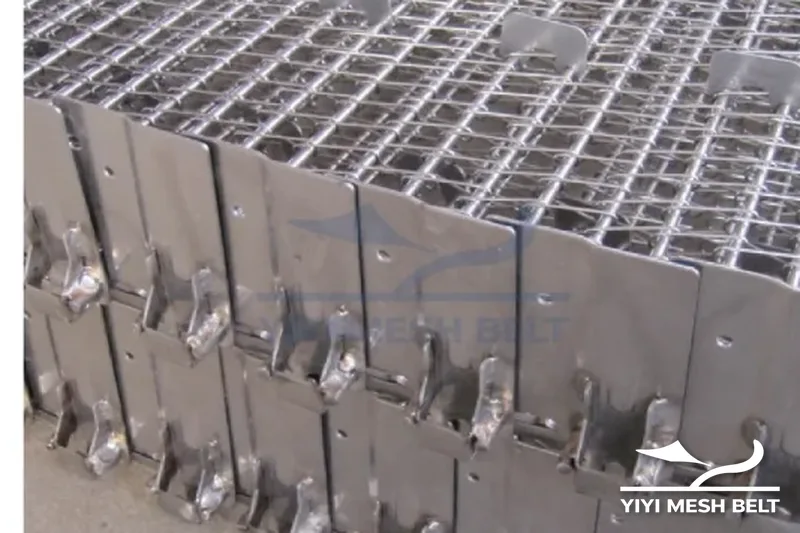
On a self-stacking belt, the grade covers the spiral wire, the rods, the side links and the stack plates, and on heavy-duty belts the reinforcement pieces as well. We build every part in the grade shown on the approved drawing. If a drawing specifies different grades for different parts, we confirm it with you before production.
| Part | How we make it | Grade |
|---|---|---|
| Spiral wire | Stainless wire drawn in-house, then formed into spirals | SUS304 or SUS316, as on the drawing |
| Rods (5 mm standard; 6 / 7 mm heavy duty) | Round bar drawn in-house | Same grade as the belt |
| Side links and stack plates (1.5 mm) | Formed to the approved geometry | Same grade as the belt |
| Reinforcement pieces (4 × 15 mm, heavy duty) | Fitted between link and mesh | Same grade as the belt |
| Washers | Fitted on the long-slot side | To the approved drawing |
Our technical specification lists SUS304 and SUS316 for both the standard and the heavy-duty constructions, so the grade does not limit the construction or the widths you can choose.
When is SUS304 enough, and when is SUS316 worth it?
Start from the product and the cleaning, not from the price list.
SUS304 is the common grade for freezing, cooling and general food conveying, and most self-stacking belts we build are SUS304. SUS316 contains molybdenum and resists chlorides better, so it is worth reviewing for salt, brine, seafood or chlorinated cleaning. Neither grade fixes a belt that does not fit the spiral.
| Check | SUS304 | SUS316 |
|---|---|---|
| Typical self-stacking use | Freezing, cooling and proofing of general food products | Lines with salt, brine, seafood or chlorinated cleaning |
| Main strength | Common grade for food processing | Better chloride resistance (molybdenum) |
| Main limit | Chlorides and aggressive cleaning chemicals | Does not fix design, fit or cleaning problems |
| Constructions | Standard and heavy duty | Standard and heavy duty |
| Finishes | Pickling / electropolishing | Pickling / electropolishing |
If your current belt is running well, its grade is a good starting point. If you are replacing a belt that corroded, tell us what the line carries and how it is cleaned, so we can look at the cause rather than just the grade.
How do we make sure the grade is what you ordered?
A grade on a drawing is a promise. The material check is the proof.
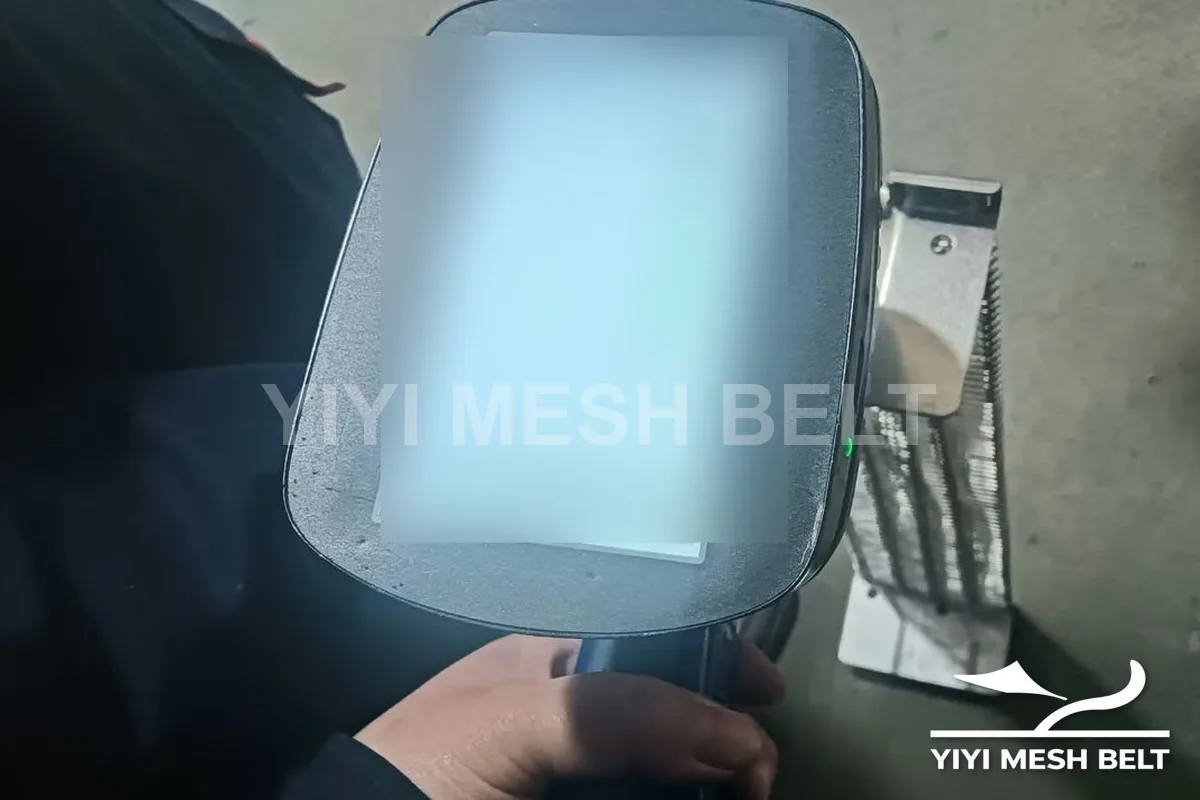
We draw our own stainless steel wire and round bar, and every incoming batch of raw material is checked for composition and hardness before production. Where the order asks for it, we record the composition check of the wire, rods and links on video, and make the side links of one order from a single batch of material.
| Check | When | What it shows |
|---|---|---|
| Composition check | Every incoming batch of wire and bar | The material is the grade on the drawing |
| Hardness check | Every incoming batch | A second property check on the same batch |
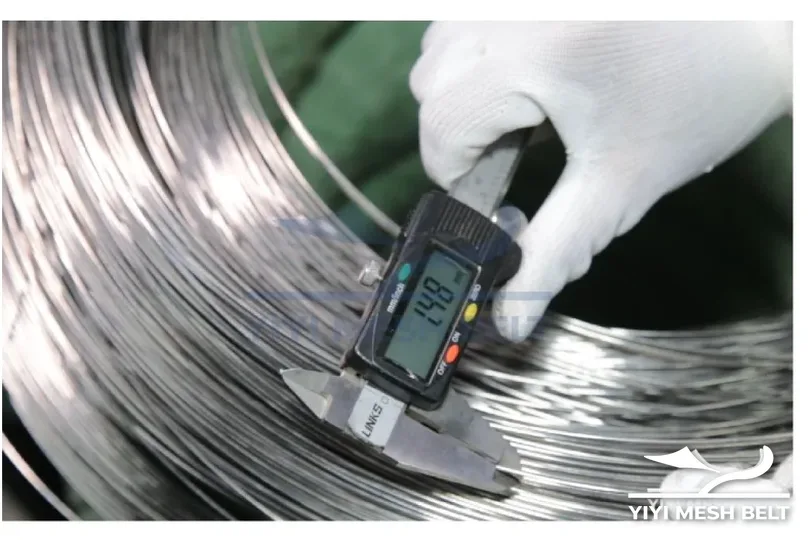
| Wire and rod diameter | Before forming | Diameters match the approved specification |
| Composition check on video | Where the order asks for it | A record of the wire, rods and links used on your order |
Do not rely on a magnet. SUS304 can become slightly magnetic after cold forming, so a magnet neither proves nor disproves the grade. Our article on magnet test or spectral analysis explains the difference. The material inspection equipment is shown on page 6 of our Self-Stacking Belt production and quality control document.
Which surface finish goes with each grade?
Grade and finish are two separate choices.
Both SUS304 and SUS316 self-stacking belts are available with pickling or electropolishing. Pickling removes the scale and heat tint left by fabrication and welding, and the surface may look matt. Electropolishing reduces micro-roughness and brightens the stainless steel. The grade decides the material; the finish decides the surface.
Most of our self-stacking orders are pickled. For a customer in Spain (Europe), the 2026 repeat orders were electropolished, while the earlier orders for the same belts were not. The grade stayed SUS304 throughout. When appearance matters, agree a finish sample first. For more on the two finishes, see our surface treatment guide.
What should you send so we can confirm the grade?
Five facts are usually enough.
Tell us the product on the belt, whether salt, brine or seafood is involved, the cleaning chemicals and method, the grade of the belt now running, and the material documents you need. With these, we confirm the grade and the finish on the drawing for your approval.
| Information | Why we need it |
|---|---|
| Product on the belt | Shows what the belt is exposed to |
| Salt, brine or seafood | The main reason to review SUS316 |
| Cleaning chemicals and method | Chlorinated cleaners point to SUS316 |
| Grade of the current belt | A belt that runs well is a good starting point |
| Material documents required | Agreed before production, not after delivery |
You can collect everything for a quote with our spiral and self-stacking inquiry checklist.
When this is not the right choice
This comparison is for wet and cold food lines. SUS316 is not a high-temperature grade, and neither grade is the answer for a furnace or a very hot oven; that is a separate material review. We build metal belts only, so if your spiral uses a plastic belt, this article does not apply. And if nobody knows which cleaning chemicals are used, find out first: choosing SUS316 "to be safe" without that answer can cost more and still miss the real cause of corrosion.
From our engineering experience
Many buyers ask for SUS316 "to be safe". Sometimes that is right. More often, the self-stacking belt runs freezing or cooling of ordinary food products, and SUS304 is the grade the line was designed with.
My advice: decide the grade from the product and the cleaning, put it on the drawing, and ask for the material check on your order. That protects you more than choosing the more expensive grade by default.
Evidence from our work
| Situation | Repeat orders for SUS304 self-stacking belts in 420 mm and 760 mm widths |
|---|---|
| What we checked | On a 2025 order: side links from a single batch of material so the colour stayed even after pickling, and the composition check of the wire, rods and links recorded on video |
| Finish | Not electropolished on the earlier orders; electropolished on the 2026 orders |
| Buyer lesson | If appearance matters, ask for links from one material batch |
The self-stacking projects described in our recent articles, in Spain, New Zealand, Pakistan, India, Saudi Arabia, South Korea, Malaysia and Australia, were all built in SUS304. For the full production sequence, see how a self-stacking belt is made on yiyimeshbelt.com.
FAQ
Is SUS304 good enough for a self-stacking belt?
For most freezing, cooling and general food conveying, yes. Most self-stacking belts we build are SUS304. SUS316 is reviewed where salt, brine, seafood or chlorinated cleaning are present.
Which parts of a self-stacking belt are made in the chosen grade?
The spiral wire, the rods, the side links and stack plates, and on heavy-duty belts the reinforcement pieces. We build every part in the grade on the approved drawing.
Can a self-stacking belt be built in SUS316 in heavy-duty construction?
Yes. Our technical specification lists SUS304 and SUS316 for both the standard and the heavy-duty constructions, with pickling or electropolishing.
How do you make sure the belt is really the grade I ordered?
We draw our own stainless steel wire and round bar, and every incoming batch of raw material is checked for composition and hardness. Where the order asks for it, we record the composition check of the wire, rods and links on video.
Can a magnet tell me whether my belt is SUS304?
No. SUS304 can become slightly magnetic after cold forming, so a magnet does not prove or disprove the grade. A composition check does.
Conclusion
Choose SUS304 for most self-stacking freezing and cooling lines, and review SUS316 for salt, brine, seafood or chlorinated cleaning. Either way, the grade covers the whole belt, and the material check on your order is what proves it.
Useful files for your project
I work on metal conveyor belt projects, from new spiral freezers to belt replacement. I share project notes and replacement checklists on LinkedIn.
Technical reviewer: Sunny Ye, Global Sales Director, YIYI MESH BELT · Last updated: 2026-10-27
© 2026 Ningjin Yiyi Mesh Belt Co., Ltd. All rights reserved. Photos, drawings and data on this page belong to YIYI Mesh Belt and may not be copied or reused without written permission.