Where Is a Self-Stacking Belt Used, and What Changes for Each Line?
A self-stacking belt can go into a freezer, a cooler or a proofer. The belt family is the same, but the line decides what we build. Here are the self stacking belt applications our specification lists, and what changes for each. See our self-stacking belts.

What is the short answer?
A self-stacking belt is used in self-stacking spiral lines for freezing, cooling and dough proofing. The checks in our factory stay the same, but the configuration changes with the line: width, side-guard height, spiral pitch, construction, grade and finish are confirmed on your approved drawing.
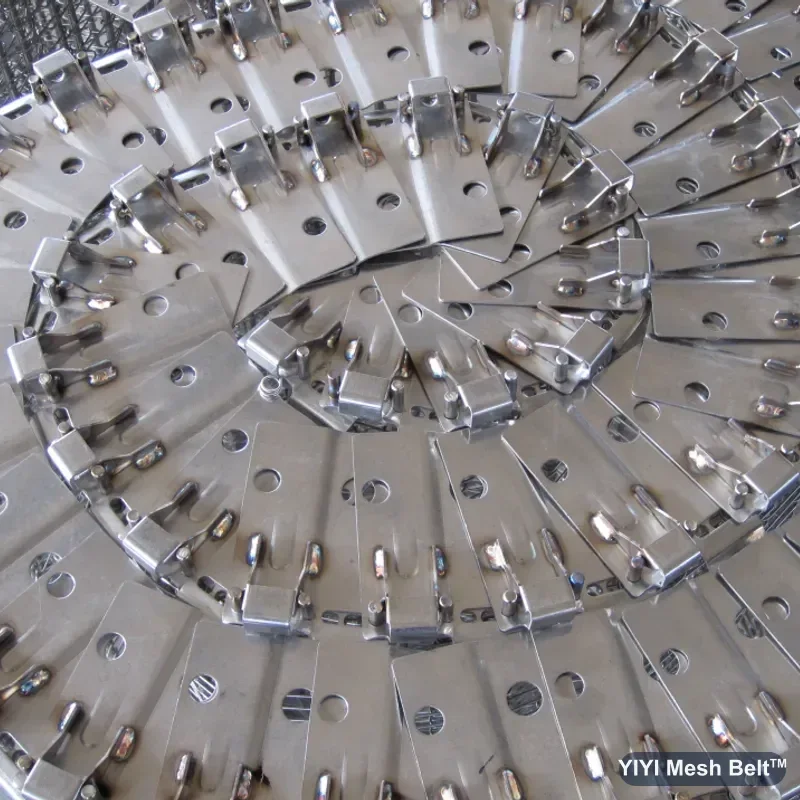
I am Sunny Ye, Global Sales Director at YIYI MESH BELT in Ningjin, Shandong, China. We draw our own stainless steel wire and round bar, and we build self-stacking belts in standard and heavy-duty constructions. This article explains where the belt is used and what we confirm for each line. For the grade question in detail, see SUS304 or SUS316 for a self-stacking belt.
| Item | Details |
|---|---|
| Product | Self-Stacking Belt, standard and heavy-duty constructions |
| Lines | Freezing, cooling and dough proofing in self-stacking spiral systems |
| Material | SUS304 / SUS316 |
| Finish | Pickling / electropolishing (electropolishing generally up to 90 mm stack plates) |
| What changes by line | Width, side-guard height, spiral pitch, construction, grade and finish |
| What stays the same | Approved drawing, trial section, stacking test, turning-diameter check, 100% final inspection |
Where is a self-stacking belt used?
A self-stacking belt is used in self-stacking spiral systems in food processing, where the side guards of each tier carry the tier above. Our technical specification lists three main food lines: freezing, cooling and dough proofing. In every case, the configuration is confirmed on the approved equipment drawing.
A conventional spiral belt is carried by rails on every tier. A self-stacking belt is not. Its stack plates, the side guards on both edges, rest on the tier below, so the belt builds its own spiral stack. That is the reason the belt goes into compact spiral systems, and it is also why the same belt family can serve three quite different lines.
| Application | What the belt does | What is selected for the line |
|---|---|---|
| Self-stacking spiral conveying | Side guards stack tier on tier | Side-guard height, confirmed with the equipment arrangement |
| Freezing | Carries product through a spiral freezing line | Belt width, side-guard height and material, selected to suit the freezer design |
| Cooling | Carries product through a self-stacking spiral cooler | Belt configuration, following the approved equipment drawing |
| Proofing | Carries dough through a self-stacking spiral proofer | Operating conditions, reviewed with the belt specification |
The specification adds one sentence that matters more than any table: suitability depends on the belt specification, the operating conditions and the equipment design. So the useful question is not only where the belt is used, but what we build differently for your line. The next three sections answer that.
What changes for a freezing line?
For a freezing line, we select the belt width, the side-guard height and the material to suit the freezer design. Most self-stacking belts we build for freezing are SUS304. We review SUS316 where salt, brine, seafood or chlorinated cleaning are present.
In a spiral freezer, the belt carries raw and cooked products through cold air, and the open mesh lets that air pass through the product from below. The belt also has to accept repeated wash-down. Those two facts shape three production decisions.
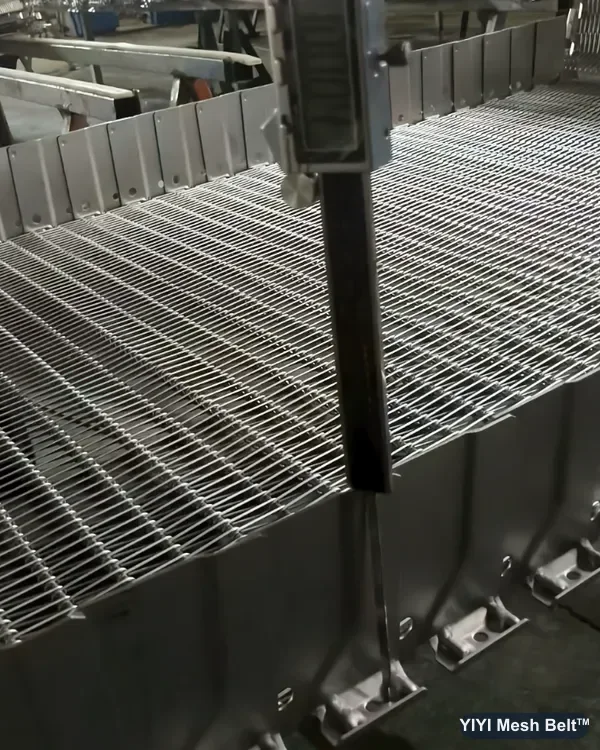
Width and side-guard height. These come from the freezer design, not from the product alone. Our standard belt is built in 420, 580, 640, 660 and 760 mm widths with side guards of 60, 80, 90, 100 or 120 mm. The heavy-duty belt adds 1069 mm and uses 80, 100 or 150 mm guards. Side-guard height is a component dimension; how it works in your freezer depends on the equipment arrangement on the drawing.
Material. SUS304 is the common grade for freezing, and the grade covers the whole belt: spiral wire, rods, side links and stack plates. SUS316 contains molybdenum and resists chlorides better, so we review it for seafood, salt, brine or chlorinated cleaning. Neither grade fixes a belt that does not fit the freezer.
Construction. Freezer builders sometimes need the heavy-duty construction, with 6 or 7 mm rods instead of 5 mm, and on the reinforced version a 4 × 15 mm reinforcement piece between link and mesh. Which construction a freezer needs is set on the approved equipment drawing; we build the one that drawing specifies.
What changes for a cooling line?
For a cooling line, the belt configuration follows the approved equipment drawing. The construction is similar to a freezing belt, but the duty is different: the product is often soft and freshly baked, so the mesh and the support under the product matter more.
Bread, buns and pastries often go into a spiral cooler straight after the oven. The belt has to give a stable, open surface so the product cools evenly, and it must turn the same way as the equipment.
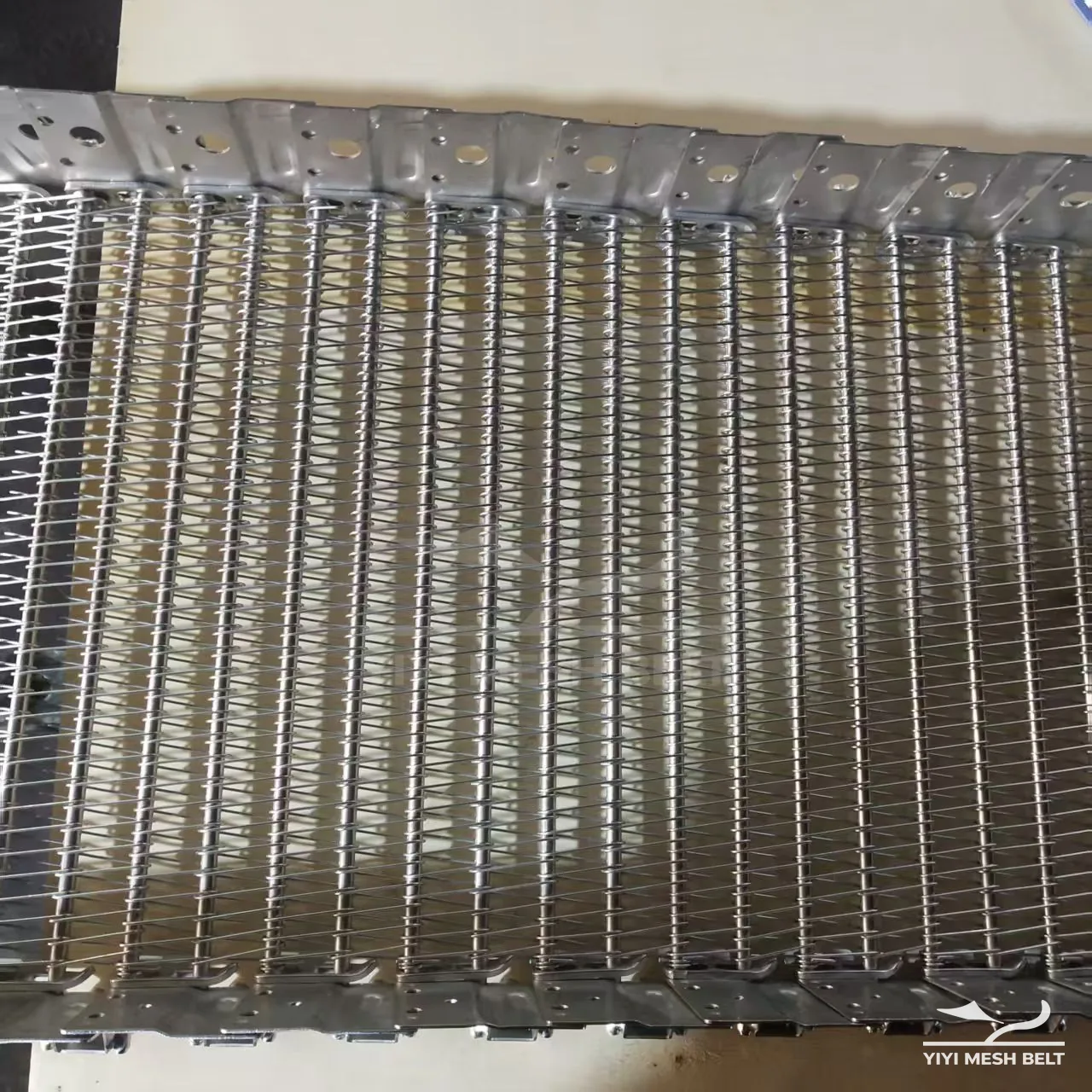
On a self-stacking belt, the mesh the product sits on is set by the spiral pitch. Our specification lists 6, 9 and 13 mm. Before we confirm the spiral pitch, we check the product size and weight, because a soft product needs steady support across the mesh. Rod pitch stays at 30 mm on both the standard and the heavy-duty belt.
The grade question is usually simpler on a cooling line. SUS304 is used for cooling of general food products. The cleaning method still decides whether SUS316 is worth reviewing, so we ask about it on cooling lines too.
| Item | Standard (mm) | Heavy duty (mm) |
|---|---|---|
| Spiral pitch | 6 / 9 / 13 | 6 / 9 / 13 |
| Rod pitch | 30 | 30 |
| Rod diameter | 5 | 6 / 7 |
| Side-guard thickness | 1.5 | 1.5 |
| Reinforcement piece | — | 4 × 15 (reinforced heavy duty) |
Listed values are options, not free combinations. The belt is built to the drawing you approve.
What changes for a proofing line?
For a proofing line, we review the operating conditions with the belt specification before we confirm the configuration. Dough rises on the belt before baking, so the spiral pitch is checked against the product, and the grade and finish are confirmed with the cleaning method.
In a self-stacking spiral proofer, dough pieces rest and rise on the belt before they go into the oven. Like the cooler, the proofer runs a soft product, so the mesh and the surface support are the first things we look at. SUS304 is the common grade for proofing of general food products.
The finish is the other decision. Most of our self-stacking orders are pickled, which removes the scale and heat tint left by fabrication and welding. Some buyers choose electropolishing, which reduces micro-roughness and brightens the stainless steel. On a self-stacking belt, electropolishing is generally limited to stack plates up to 90 mm high; for taller stack plates, confirm the finish before ordering.
What stays the same on every line?
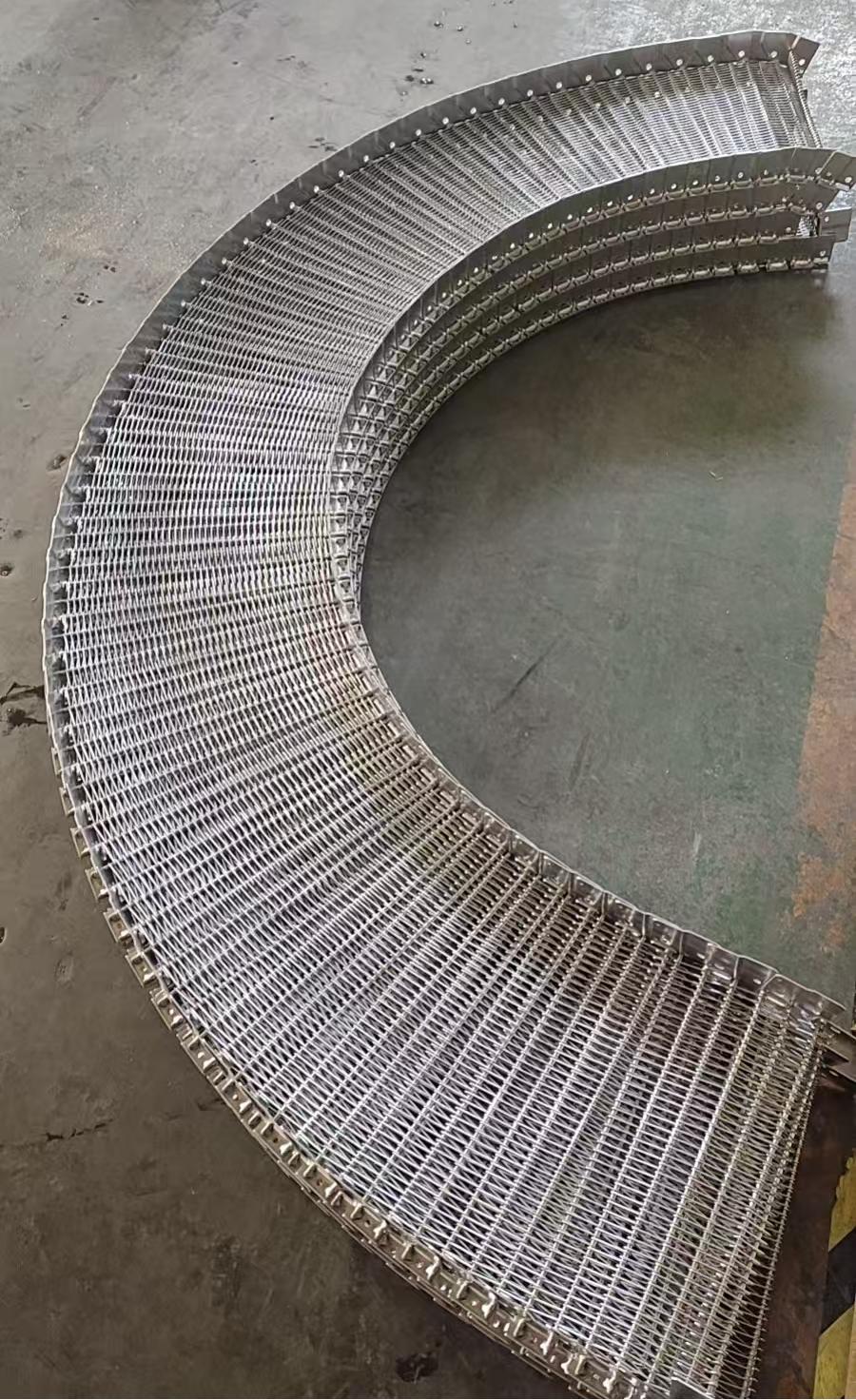
The factory checks do not change with the line. Every formal order follows your approved drawing, trial production and first-article confirmation, receives a 100% final inspection before packing, and every self-stacking belt order is hand-stacked and checked at the turning diameter before shipment.
A freezer, a cooler and a proofer ask different questions of the belt. The way we build and check it is the same, because the risk is the same: tiers that do not engage when the belt is already in your spiral.
| Stage | What we check |
|---|---|
| Incoming material | Composition (spectral test) and hardness on every batch of wire and bar |
| Before forming | Wire and rod diameters against the approved specification |
| Plate forming | Stack plate angle with an angle gauge against the approved drawing |
| Trial section | All dimensions against the drawing; first-article confirmation |
| Stacking test | About 3.3 m of belt stacked by hand in a circle about 10 times |
| Before shipment | Hand-stacked and checked at the turning diameter; 100% final inspection before packing |
How do we confirm the configuration for your line?
We confirm it on the approved equipment drawing. The line tells us which questions to ask; the drawing fixes the answers: width, side-guard height, spiral pitch, construction, grade and finish. Nothing goes into production until you approve that drawing.
| Line | First questions we ask | Fixed on the drawing |
|---|---|---|
| Freezing | Freezer design, product, cleaning | Width, side-guard height, construction, grade |
| Cooling | Product size and weight, equipment | Spiral pitch, width, side-guard height |
| Proofing | Operating conditions, dough product, cleaning | Spiral pitch, grade, finish |
If the line changes, the drawing changes. A belt that ran well in a cooler is not automatically right for a freezer, even when the width is the same. On a reorder, we build to the approved drawing of the previous order and quote that order on the new production order.
When is this not the right choice?
This article is about self-stacking belts. A drum-driven spiral freezer belt runs on rails and has no stack plates, so the choices above do not apply to it. If your spiral runs a plastic belt, this article does not apply either; we build metal belts only. We do not give temperature limits, service life or output figures here. Those depend on your equipment and operating conditions, and they are reviewed for each project.
Which configurations have we built?
We build both constructions and the full range of side-guard heights. The projects below show configurations, not end products. The self-stacking projects described in our recent articles were all built in SUS304.
| Project | Configuration | What it shows |
|---|---|---|
| South Korea (East Asia) | Heavy duty, 420 and 660 mm, 7 mm rods, 1.5 × 80 mm stack plates, 4 × 15 mm reinforcing bars | Heavy-duty construction built to an equipment manufacturer's design |
| Australia (Oceania) | SUS304, 760 mm, 1.5 × 120 mm stack plates, made to the distributor's sample | Tall stack plates; engagement checked before, during and after welding |
| India (South Asia) | SUS304, 420 mm, 90 mm stack plates, collapsible on one side | Plate geometry set on the drawing, including a 45° foot |
| New Zealand (Oceania) | SUS304, 660 mm / 80 mm and 420 mm / 60 mm guards, repeat orders since 2017 | Two widths for one customer, each with its own drawing |
What do buyers ask about applications?
Where is a self-stacking belt used?
In self-stacking spiral systems in food processing. Our technical specification lists freezing, cooling and dough proofing. The configuration is confirmed on the approved equipment drawing.
Is the same self-stacking belt used for freezing and cooling?
The construction is similar, but the duty is different. For freezing we select width, side-guard height and material to suit the freezer. For cooling the product is often soft, so the spiral pitch and support matter more.
Which grade is used for self-stacking freezing, cooling and proofing?
SUS304 is the common grade for freezing, cooling and proofing of general food products. SUS316 is reviewed where salt, brine, seafood or chlorinated cleaning are present.
Which side-guard heights are available?
Standard belts: 60, 80, 90, 100 and 120 mm. Heavy-duty belts: 80, 100 and 150 mm. The height is chosen to suit the equipment arrangement on the approved drawing.
Are the factory checks different for each line?
No. Every order follows the approved drawing, trial production and first-article confirmation, a 100% final inspection before packing, and a hand-stacking and turning-diameter check before shipment.
What should you take from this?
Freezing, cooling and proofing use the same belt family. The line decides the configuration; the approved drawing fixes it; our checks stay the same.
What have I learned from these lines?
One customer came to us while replacing the belt on a spiral IQF freezing line. Belts from the original equipment maker were costly for them, so before the old belt was due to be changed, they sent us a worn sample and asked us to build the new belt from it. We first compared the sample with the tooling we have built up over the years, to see where it differed. Then we measured it completely: the overall width, the side-guard height and thickness, the spiral pitch, the rod pitch and the wire diameter, and we tested the hardness of the stainless steel.
We sent the data back to the customer, and they confirmed it. We then sent a trial sample, which they approved. Before mass production, we placed their original sample next to our new section and joined the two. Only when they connected without any problem did we start the full length.
My advice: if belts from your original equipment maker cost too much for your line, a worn sample can be where a replacement starts, as long as every dimension is measured and confirmed in writing, and the new belt is joined to the original before mass production. We are glad to take on replacement projects like this.
Which files can help your project?
I work on metal conveyor belt projects, from new spiral freezers to belt replacement. I share project notes and replacement checklists on LinkedIn.
Technical reviewer: Sunny Ye, Global Sales Director, YIYI MESH BELT · Last updated: 2026-11-11
© 2026 Ningjin Yiyi Mesh Belt Co., Ltd. All rights reserved. Photos, drawings and data on this page belong to YIYI Mesh Belt and may not be copied or reused without written permission.