How Do We Inspect a Self-Stacking Belt Trial Section Before Mass Production?
If one dimension on a self-stacking belt is wrong, every tier in the stack carries the error. Found after mass production, that error runs the full length of the belt. So our self-stacking belt first article inspection happens on a short trial section, before the full belt is built. See our self-stacking belts.

What is the short answer?
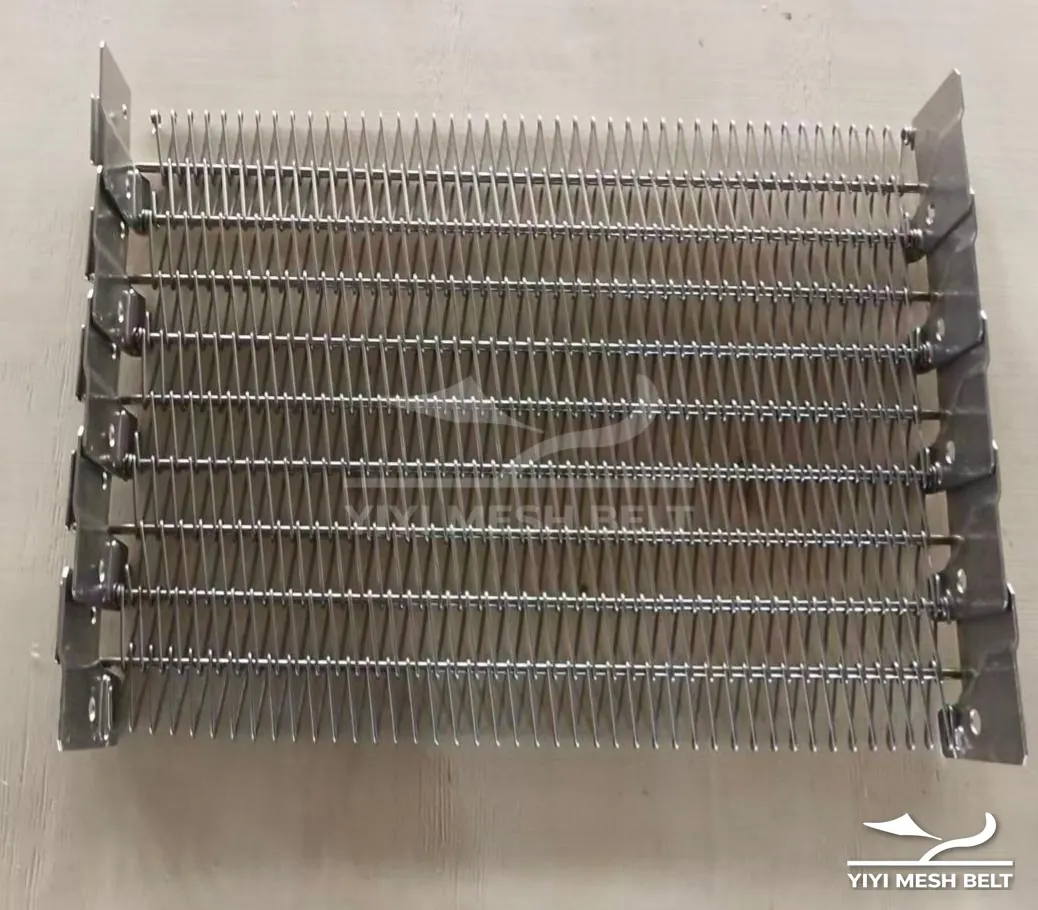
We build a trial section, measure all specifications against the approved drawing, and check the edge welds and stack plate squareness. Then we send you photos to confirm. Customized self-stacking belt orders go through this first-article inspection before mass production starts.
I am Sunny Ye, Global Sales Director at YIYI MESH BELT in Ningjin, Shandong, China. This article is only about the self-stacking belt. For conveyor belts in general, see what happens before bulk production of a metal conveyor belt.
What is a self-stacking belt trial section?
A trial section is a short piece of your belt, built before mass production. We check it against the approved drawing and photograph it for you. Customized orders go through it, so you confirm a real piece of the belt and not only a drawing.
| Item | Details |
|---|---|
| Product | Self-Stacking Belt, stainless steel SUS304 / SUS316 |
| Applies to | Customized orders, before mass production |
| Reference | The approved drawing; acceptance dimensions and tolerances follow it |
| Most common faults | Edge weld points and stack plate squareness |
| Your part | You confirm the photos we send |
Acceptance tolerances are agreed for each project. That is why this article does not list one general tolerance.
What does self-stacking belt first article inspection check?
We check all the specification data against the drawing: wire, rod, rod pitch, spiral pitch, stack plate thickness and height, belt width and the stack plate angle. On a heavy-duty belt, we also measure the slot sizes in the stack plates. These are first-article checks, made before production continues.
| Item | Tool | Checked against |
|---|---|---|
| Wire diameter | Digital caliper | Approved drawing |
| Rod diameter | Digital caliper | Approved drawing |
| Rod pitch | Digital caliper | Approved drawing |
| Spiral pitch | Digital caliper | Approved drawing |
| Stack plate thickness | Digital caliper | Approved drawing |
| Stack plate height | Digital caliper | Approved drawing |
| Belt width | Steel tape, at five points or more | Approved drawing |
| Stack plate angle | Angle gauge | Approved geometry |
| Stack plate squareness | 90° square | Approved drawing |
| Slot sizes (heavy-duty project) | Measured on the first section | Approved drawing |
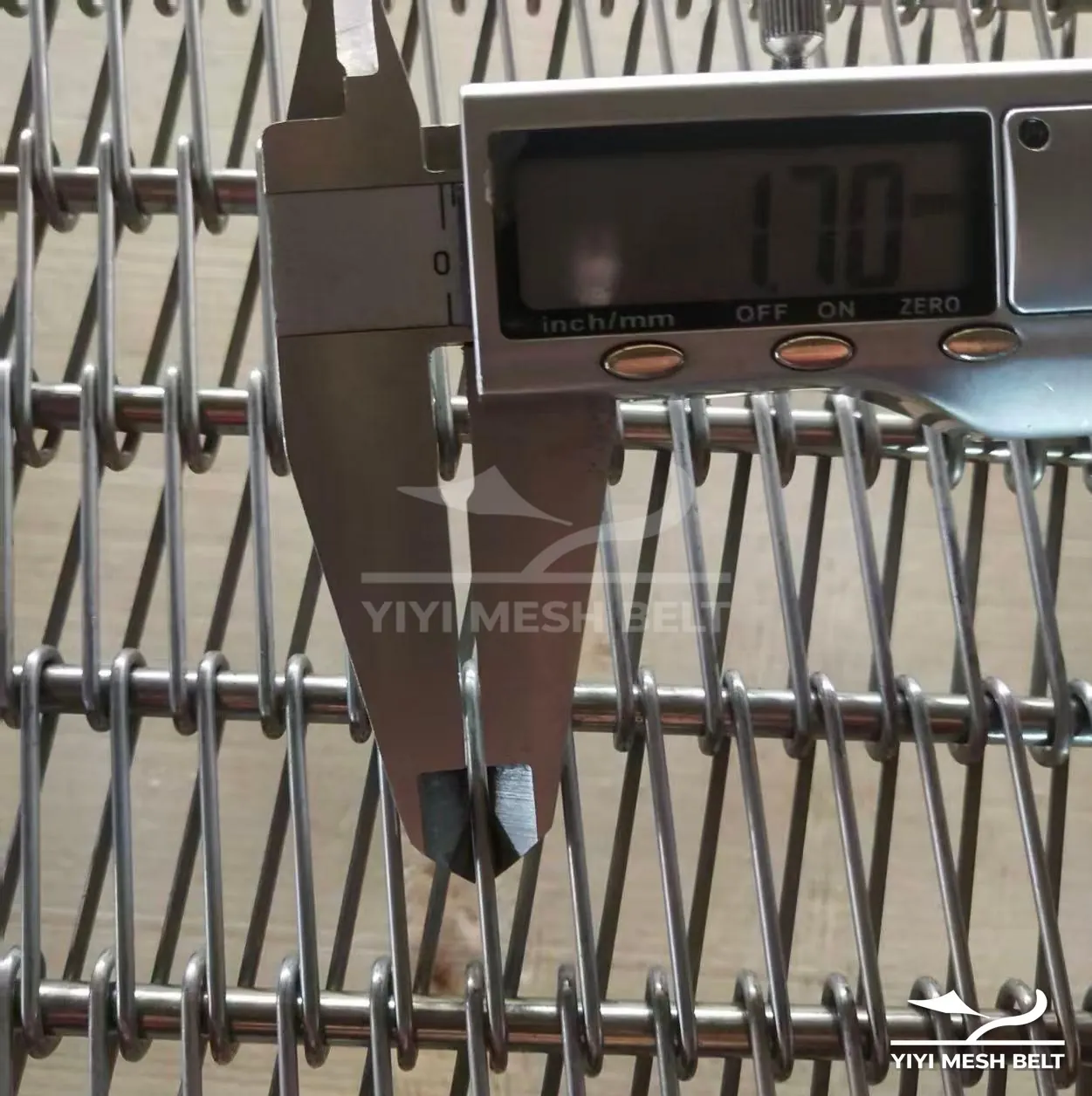
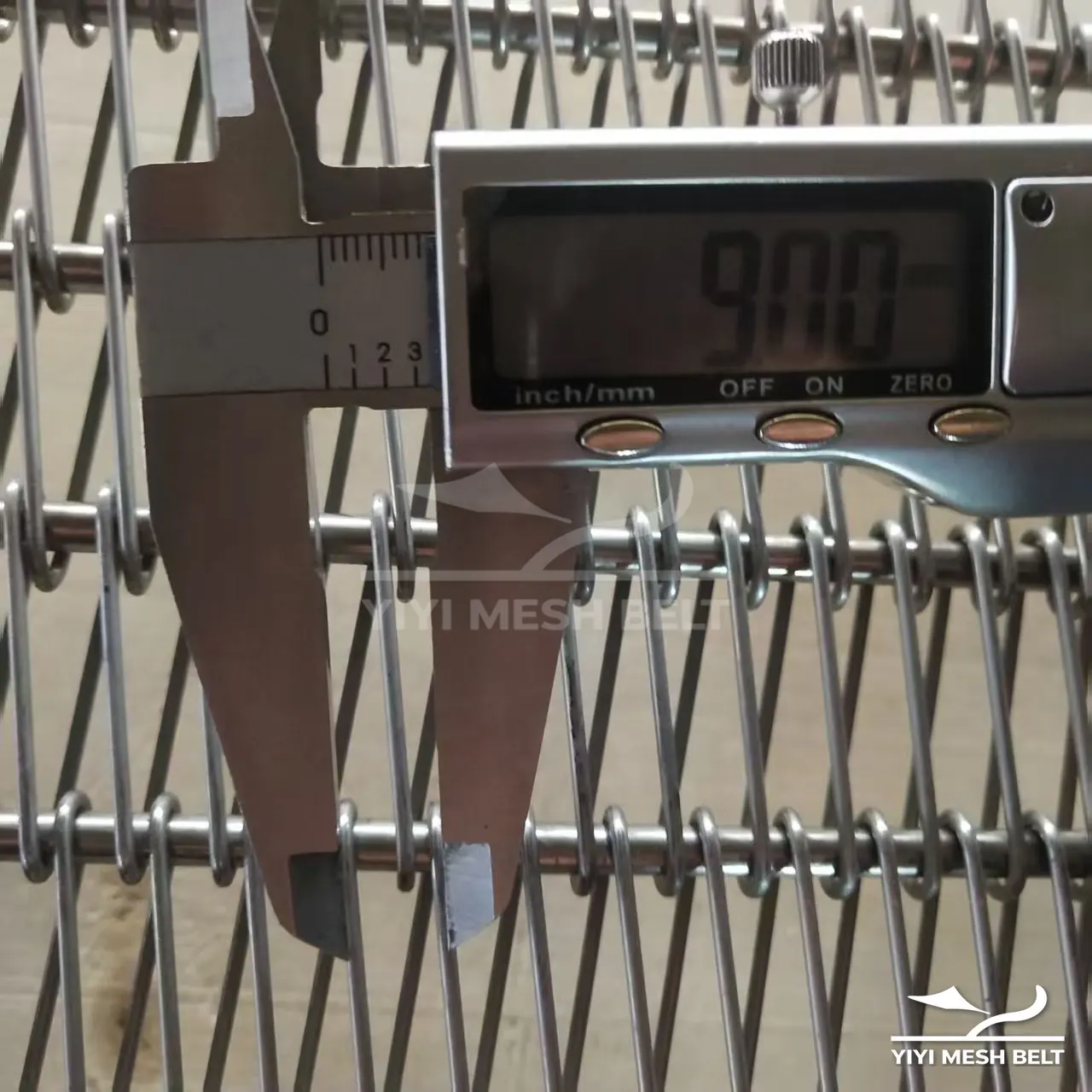
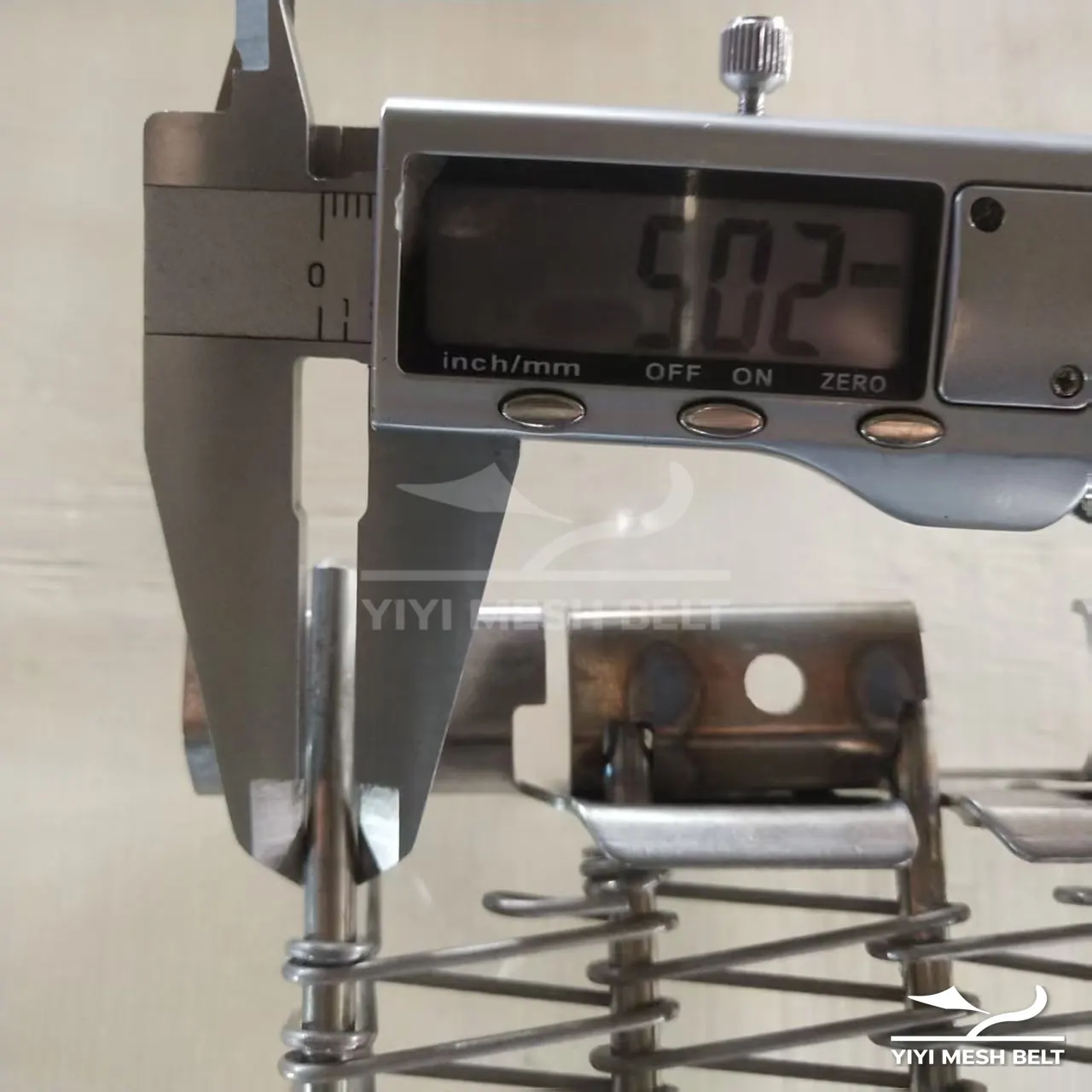
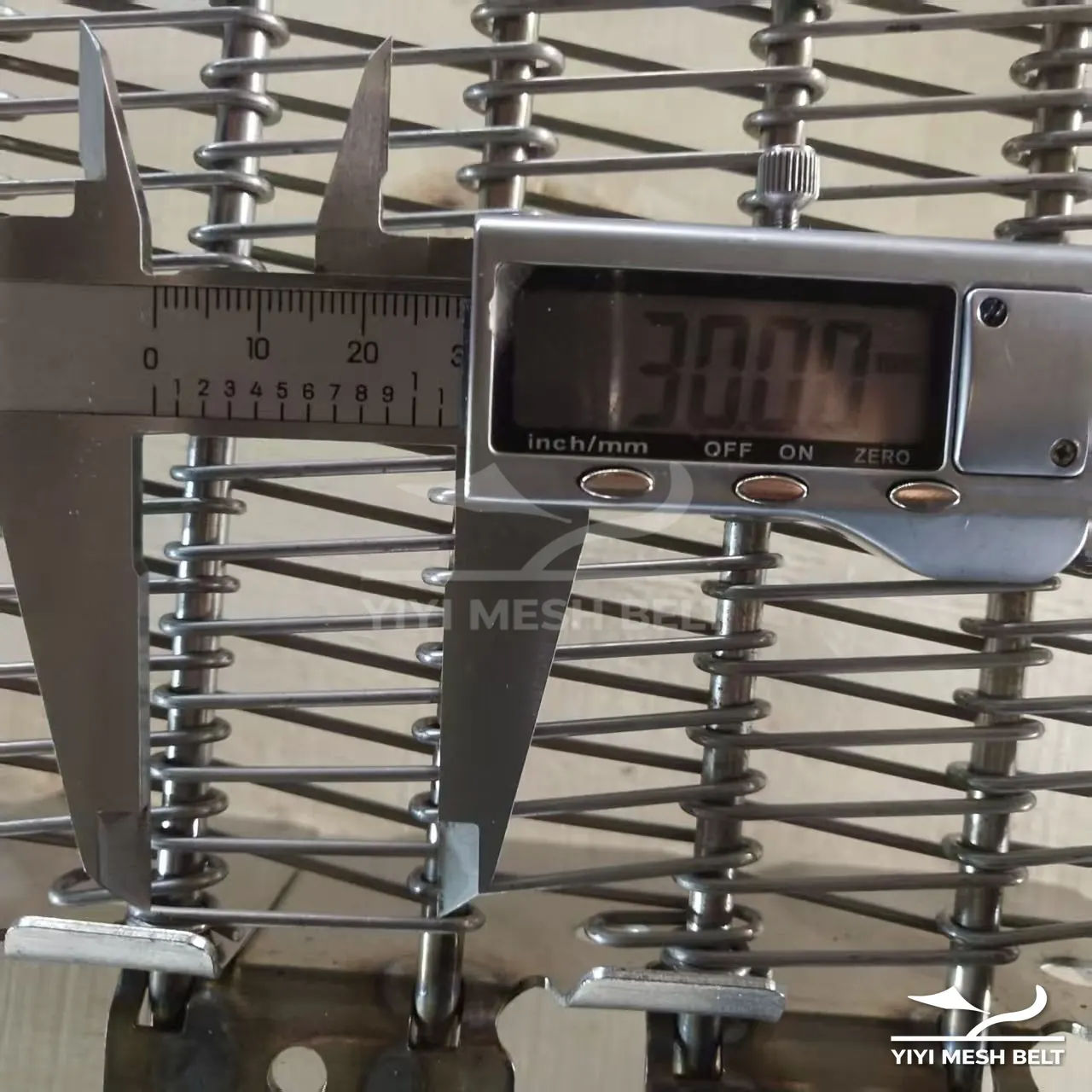
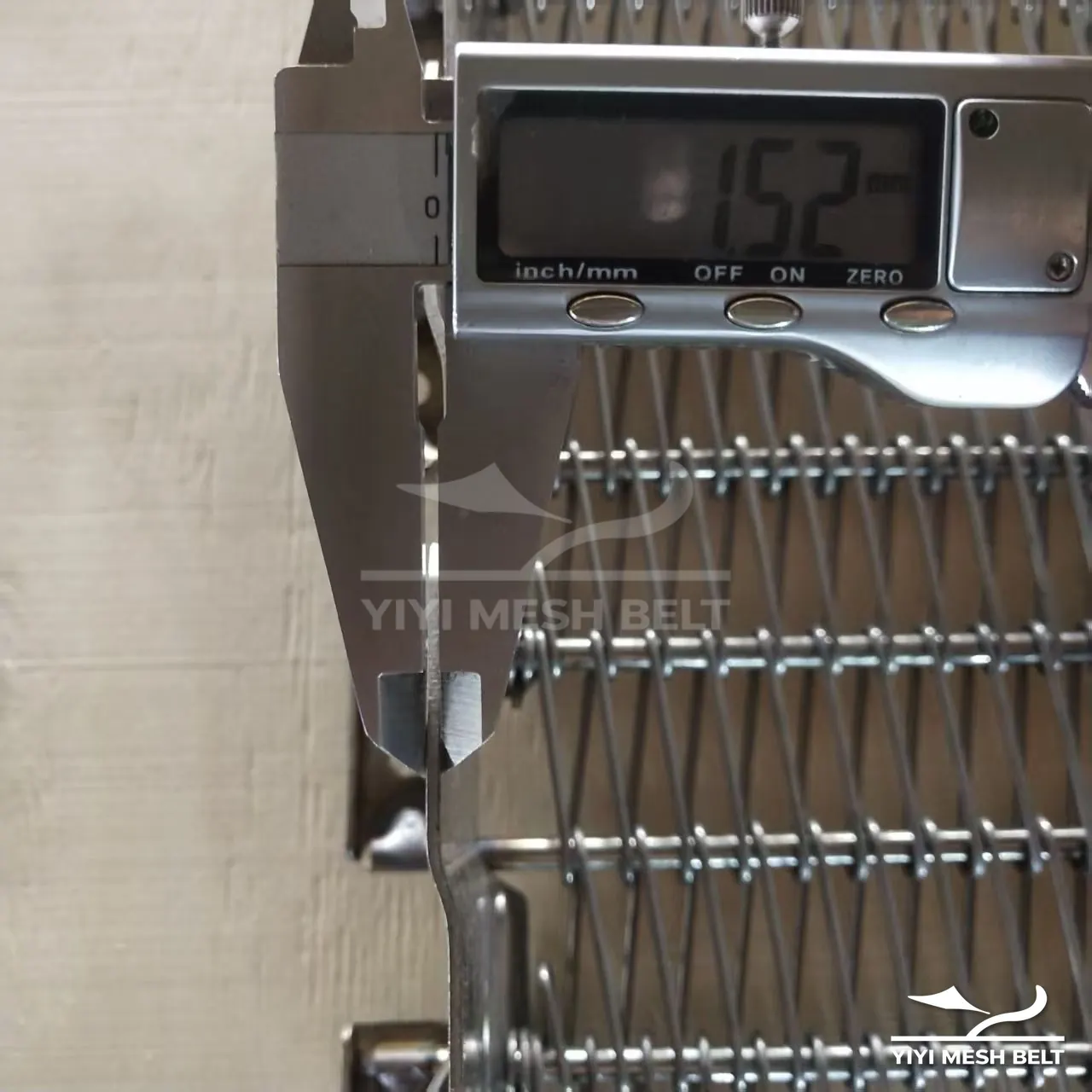
The table shows the drawing value and our reading for one 2026 order. They are project values, not universal belt dimensions.
| Item | Drawing (mm) | Reading (mm) | Inch (in), rounded |
|---|---|---|---|
| Wire diameter | 1.7 | 1.70 | 0.07 |
| Spiral pitch | 9 | 9.00 | 0.35 |
| Rod diameter | 5 | 5.02 | 0.20 |
| Rod pitch | 30 | 30.00 | 1.18 |
| Stack plate thickness | 1.5 | 1.52 | 0.06 |
| Stack plate height | 60 | Checked with a height gauge | 2.36 |
Inch values are rounded references. Options are not free combinations; the approved drawing governs.
Which faults do we find most often?
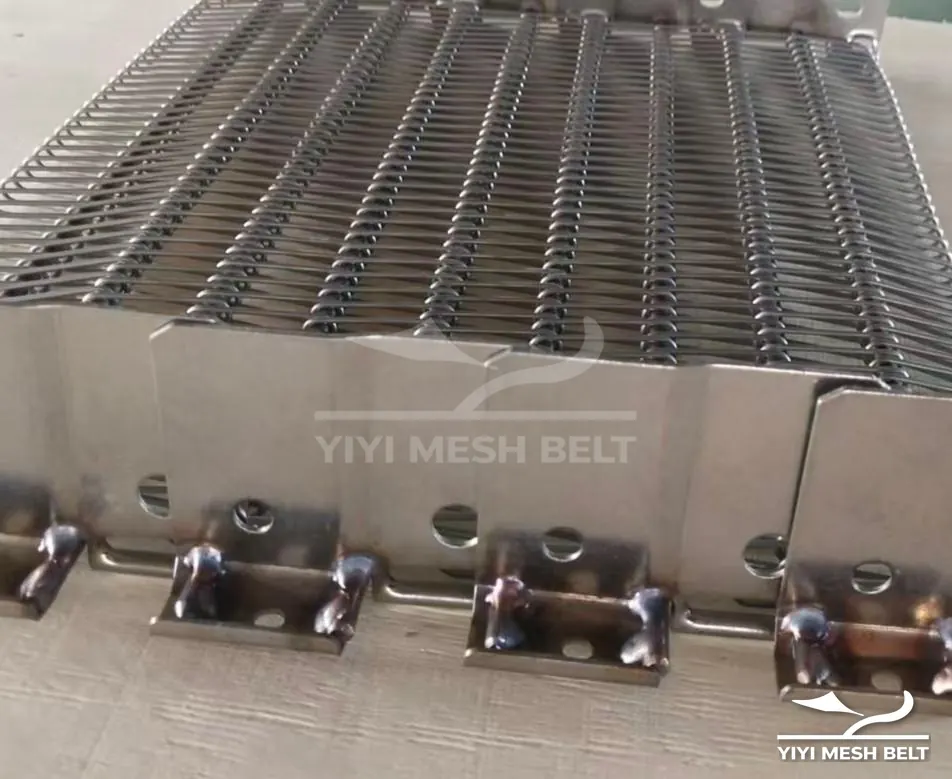
On a first article, the most common faults are at the edge: the weld points, and the squareness of the stack plates. We check squareness and height with a 90° square. Weld slag on the back of the edge also matters, because it affects how the belt stacks.
| Point | How we check it |
|---|---|
| Edge weld points | Each weld pressed by hand; position centred, no loose points |
| Stack plate squareness | Measured with a 90° square, with the stack plate height |
| Weld slag on the back of the edge | Inspected and ground by hand during welding |
| Rods | Every rod straight, so the stack plates stay vertical |
How do we check the stacking?
We stack the section by hand in a circle and look at how well the upper and lower tiers engage. Measuring tells us the parts match the drawing. Stacking shows us how the tiers meet. If they do not engage, we adjust the tooling before mass production.
This is separate from the shipment check: every self-stacking belt order is hand-stacked and checked at the turning diameter before shipment.
What do you receive and confirm?
You receive photos of the section, with the measured values, and you confirm them. Where we built to your sample, we can also send a written comparison of our sample against your original. We keep the approved drawing, inspection photos and your confirmations for reorders.
| Item | What it shows you |
|---|---|
| First-article photos with measured values | The section against your drawing |
| Written sample comparison | Small differences from your original, explained before production |
| Marked-up photos | Plate details for you to confirm, such as hole position and bend angle |
| Our drawing | The data your repeat orders are checked against |
See our quality control and inspection page for the wider checks, and industries for where our belts are used.
What happens if the trial section does not pass?
It does not go on to mass production. We correct the fault, such as adjusting the tooling, and check again. On a heavy-duty project in South Korea, we adjusted the link tooling on the trial order. It is far cheaper to find that here than on a full belt.
When is a full trial section not the right step?
For a straight repeat order to an approved drawing, the first article check is usually enough, although some buyers ask for a trial before every reorder. A worn sample is different: it shows the wear, not the original size, so critical dimensions must be confirmed first.
This page covers self-stacking belts only. A drum-driven Spiral Freezer Belt runs on rails and has no stack plates.
Where have we done this?
Four projects show different sides of it: a 2026 order in the Middle East where mass production waited for the buyer's confirmation, a food manufacturer in New Zealand with a trial section before each repeat order, a new heavy-duty design in South Korea, and a wide belt in Malaysia where small differences from the sample were explained in writing.
| Situation | A buyer ordered 173 m (568 ft) of SUS304 self-stacking belt, 420 mm (16.54 in) wide, delivered in 3.3 m (10.8 ft) sections, pickled, to the same quality as an earlier order |
|---|---|
| Drawing | Spiral pitch 9 mm, rod pitch 30 mm, wire 1.7 mm, rod 5 mm, stack plates 1.5 × 60 mm (0.06 × 2.36 in), welded edge |
| What we checked | A trial section measured against the drawing; the readings are in the table above |
| What happened next | The buyer confirmed the trial-section photos, then mass production started |
| Situation | A food manufacturer reorders SUS304 belts in 660 mm (25.98 in) and 420 mm (16.54 in) widths, with 30 mm (1.18 in) rod pitch and 1.5 × 80 mm (0.06 × 3.15 in) stack plates |
|---|---|
| What we checked | A trial section measured against the drawing before each repeat order went into production |
| What you can ask for | Trial-production photos before your reorder starts |
| Situation | An equipment manufacturer needed a heavy-duty belt with 7 mm (0.28 in) rods, 1.4 mm (0.06 in) wire, 10 mm (0.39 in) spiral pitch and 1.5 × 80 mm (0.06 × 3.15 in) stack plates |
|---|---|
| Before production | Drawing approved after four revisions; plate details such as hole position and bend angle confirmed in marked-up photos |
| What we checked | Rod, spiral pitch and the slot sizes in the stack plates, measured on the first section |
| What you can ask for | First-article photos with the measured values |
| Situation | A belt distributor needed a wide SUS304 belt matched from a short sample |
|---|---|
| What we checked | Stack plates, rod pitch and width on the first section before mass production |
| What we sent | A written comparison: the clip tab shape and weld seam length differed slightly from the original |
| What you can ask for | A written comparison of our sample against your original |
What do buyers ask about trial sections?
What do you measure on the trial section?
All the specification data against the approved drawing: wire, rod, rod pitch, spiral pitch, stack plate thickness and height, belt width and the stack plate angle.
What are the most common first-article faults?
The edge weld points and the squareness of the stack plates. We check squareness and height with a 90° square.
Do I get to confirm the trial section?
Yes. We send you photos with the measured values for your confirmation before mass production.
Do you make a trial section for a repeat order?
For a straight repeat order to an approved drawing, the first article check is usually enough. Some buyers ask for a trial section before every reorder, and we measure it against the same drawing.
What should you take from this?
A trial section lets you confirm a real piece of the belt. We build it, measure it against the drawing, look first at the edge welds and stack plate squareness, and send you photos before mass production.
What have I learned from trial sections?
When the trial section is out, we test whether all the specification data match the drawing, and we take photos for the customer to confirm. The faults we see most often are the weld points at the edge and the squareness of the stack plates. To check them, we use a 90° square on the stack plate and test its height.
Which files can help your project?
I work on metal conveyor belt projects, from new spiral freezers to belt replacement. I share project notes and replacement checklists on LinkedIn.
Technical reviewer: Sunny Ye, Global Sales Director, YIYI MESH BELT · Last updated: 2026-11-03
© 2026 Ningjin Yiyi Mesh Belt Co., Ltd. All rights reserved. Photos, drawings and data on this page belong to YIYI Mesh Belt and may not be copied or reused without written permission.